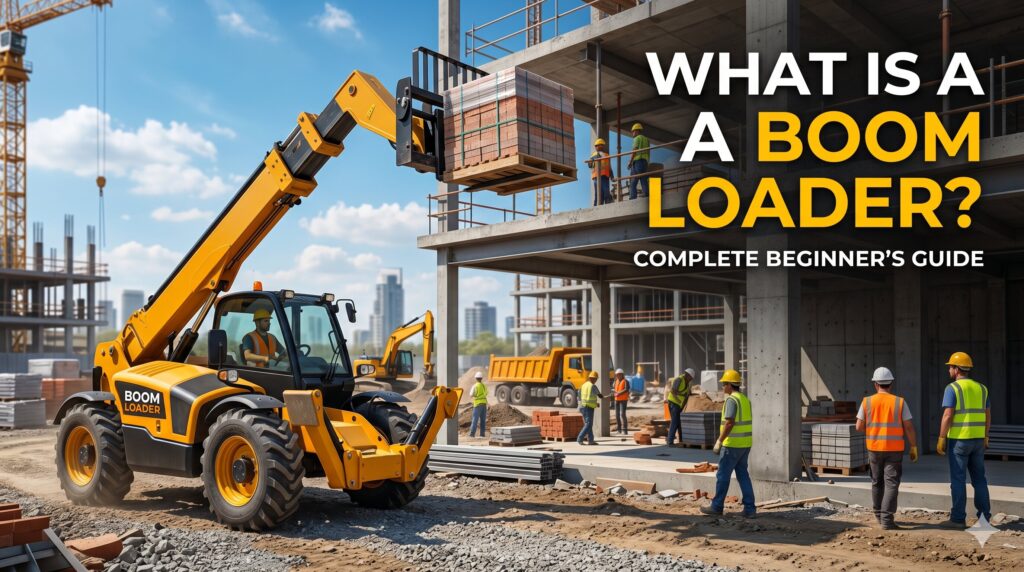

If you’ve ever watched construction sites, demolition projects, or industrial yards from a distance, you’ve probably seen a boom loader in action — a machine with an extended arm reaching out and grabbing materials like it has a mind of its own. But what exactly is this machine? How does it work, and why do companies invest in them? Whether you’re curious about construction equipment or looking to buy a boom loader for your operation, this guide covers everything a beginner needs to understand.
The heavy equipment industry uses dozens of specialised machines, each designed to solve a particular problem on site. A boom loader is one of those machines that does a lot more than its name might suggest — and understanding its capabilities is the first step toward recognising where one could save time and money in your business.
What Exactly Is a Boom Loader?
A boom loader is a wheeled or tracked vehicle equipped with a long, articulated arm (or “boom”) that extends horizontally and vertically, paired with a bucket or grabbing attachment at the end. Unlike a traditional wheel loader, which has its bucket fixed rigidly to the front of the chassis, a boom loader’s boom can reach out, lift, rotate, and place materials with precision in directions a standard loader cannot.
The boom itself is hydraulically controlled, which allows the operator to manipulate it with remarkable dexterity. The bucket at the tip can typically rotate 360 degrees, giving operators the ability to scoop, grab, rotate, and deposit materials in tight spaces, elevated positions, or at awkward angles that would be impossible with fixed-bucket equipment.
Key Distinction
Don’t confuse a boom loader with a standard wheel loader or a telescopic handler. The boom on a loader provides articulation and reach that standard loaders lack, making it ideal for tasks requiring precision placement and obstacle navigation.
How Does a Boom Loader Work?
Operating a boom loader is a skill that requires training, but the mechanical principle is straightforward. The vehicle sits on a stable base (either wheels or tracks), and the boom extends from this base like a mechanical arm. Hydraulic cylinders control each segment of the boom — the main arm, the secondary arm, and the bucket — allowing the operator to position the bucket exactly where material needs to be placed.
The Main Components
The Boom Structure: Typically made of high-tensile steel, the boom consists of two or three articulated sections that telescope and pivot. This gives it both horizontal reach and vertical lift capability.
Hydraulic System: Multiple hydraulic cylinders power each joint in the boom. Proportional controls in the cabin allow the operator to move the boom smoothly and precisely — essential when placing delicate materials or working in congested areas.
The Bucket or Attachment: The standard bucket is a wide scoop, but boom loaders can be outfitted with clamshells (for grabbing loose materials), magnets (for metal), grapples (for timber or demolition waste), or custom attachments for specific materials.
Counterweight System: Because the boom extends load outward, the vehicle has a reinforced rear and often a rear weight to balance the forward load and prevent tipping. This is critical for stability during operation.
Industries Where Boom Loaders Are Essential
The versatility of a boom loader means it shows up across dozens of industries. Here’s where you’ll most commonly see them at work:
Where Boom Loaders Make a Difference
🏗️
Construction & Demolition Loading and unloading trucks, sorting rubble, and placing materials into elevated positions during building.
🌳
Timber & Wood Processing: Moving logs, stacking timber, loading kiln trucks — the precision boom makes handling logs safer and faster.
♻️
Recycling & Scrap Yards: Sorting mixed waste, loading compactors, handling magnetic scrap — attachments vary by material type.
🏭
Ports & Logistics Loading containers and cargo that can’t be accessed by cranes, or working in confined dock areas.
🏢
Landscaping & Grounds Maintenance: Moving heavy rocks, mulch, soil, and landscaping materials in tight residential or commercial spaces.
⛏️
Mining & Quarrying Loading aggregate, ore, or overburden into trucks where fixed-bucket loaders are limited by terrain.
Boom Loader for Sale: What to Consider Before Buying
If you’re looking to buy a boom loader or exploring options in the market, the decision depends on your specific operations. Here are the critical factors:
Size and Capacity
Boom loaders come in a range of sizes, from compact models (5-ton capacity) to heavy-duty units (25+ tons). Your choice depends on the weight of materials you’re moving and the spaces you’re working in. A tight urban construction site demands a smaller, more agile machine; a large quarry might justify a heavier model.
New vs. Used Equipment
A new boom loader from a major manufacturer (like CAT, Komatsu, or Liebherr) provides warranty coverage and full service support. Used models cost significantly less but require careful inspection for hydraulic leaks, boom wear, and engine condition. In the UAE, where equipment is heavily used on dusty sites, used machines require extra scrutiny of cooling systems.
Fuel Type and Operating Costs
Most boom loaders run on diesel, though some models offer LPG (liquefied petroleum gas) options. Fuel consumption typically ranges from 25 to 40 litres per day of active operation. Operating costs should factor into your ROI calculation when deciding whether to buy a boom loader in the UAE or rent one for specific projects.
Pro Tip
In the UAE market, equipment dealers often offer better financing and maintenance packages for newer models. Renting a boom loader for a short-term project is often more cost-effective than purchasing — consider your project timeline carefully.
Boom Loaders in the UAE Market
The UAE’s construction boom and active logistics sector mean a steady supply of boom loader equipment. Whether you’re sourcing equipment for Dubai, Abu Dhabi, or other Emirates, dealers typically stock several sizes and can source specific models. When shopping for a boom loader for sale in the UAE, establish relationships with authorised distributors who stock spare parts and can arrange trained technicians for maintenance.
Frequently Asked Questions
What’s the difference between a boom loader and a skid-steer loader?
Great question — they’re often confused. A skid-steer loader is compact with a fixed bucket on the front and zero-radius turning (it pivots in place). A boom loader has an articulated arm that extends outward and upward, giving it reach and precision placement that a skid-steer can’t match. A skid-steer is better for tight trenching and confined spaces; a boom loader excels at loading trucks, placing materials at height, or working around obstacles. In dense urban construction in the UAE, you’ll see more skid-steers. In quarries and timber yards, boom loaders dominate because of their reach and load capacity.
How much does it cost to rent a boom loader on a daily or weekly basis?
Daily rental rates for a boom loader typically range from AED 500–1,500 per day in the UAE, depending on machine size and local demand. Weekly rates often offer 15–20% discounts, and monthly contracts can drop further. Larger, heavier machines cost more than compact models. Most rental agreements include operator support or operator certification requirements — you typically can’t just grab the keys without proven boom loader experience. Always factor fuel and transportation to/from the site into your budget. For projects lasting more than 6–8 weeks, buying used equipment often becomes economically competitive with renting.
Do I need special certification or training to operate a boom loader?
In most countries, including the UAE, operating heavy equipment like a boom loader requires formal certification or a Heavy Equipment Operator’s Licence. You’ll typically need to complete a training course (usually 2–4 weeks) covering machine operation, safety protocols, load calculations, and site-specific rules. Some larger equipment rental companies provide in-house training; others require you to bring a certified operator. Operators with boom loader experience are in high demand on job sites because improper operation can cause accidents or equipment damage, which is why training isn’t optional, it’s a safety and legal requirement.
Is a boom loader worth buying if I only have occasional projects, or should I stick with renting?
If you’re running occasional projects — say, fewer than three months per year of active boom loader use — renting is almost always more cost-effective. Ownership costs include depreciation, insurance, maintenance, hydraulic fluid changes, and storage. A boom loader sits idle when not in use, bleeding money. However, if you have regular work — monthly loading jobs, seasonal contracts, or a scrap/recycling operation running year-round — ownership becomes financially sensible. Run the numbers: compare your annual rental costs against the depreciation, maintenance, and insurance of a used machine. In the UAE, where equipment ages quickly in dusty, hot conditions, buying a quality used boom loader with a remaining service life of 3–5 years often makes sense for active businesses.
Thanks, bloggingarena.com
