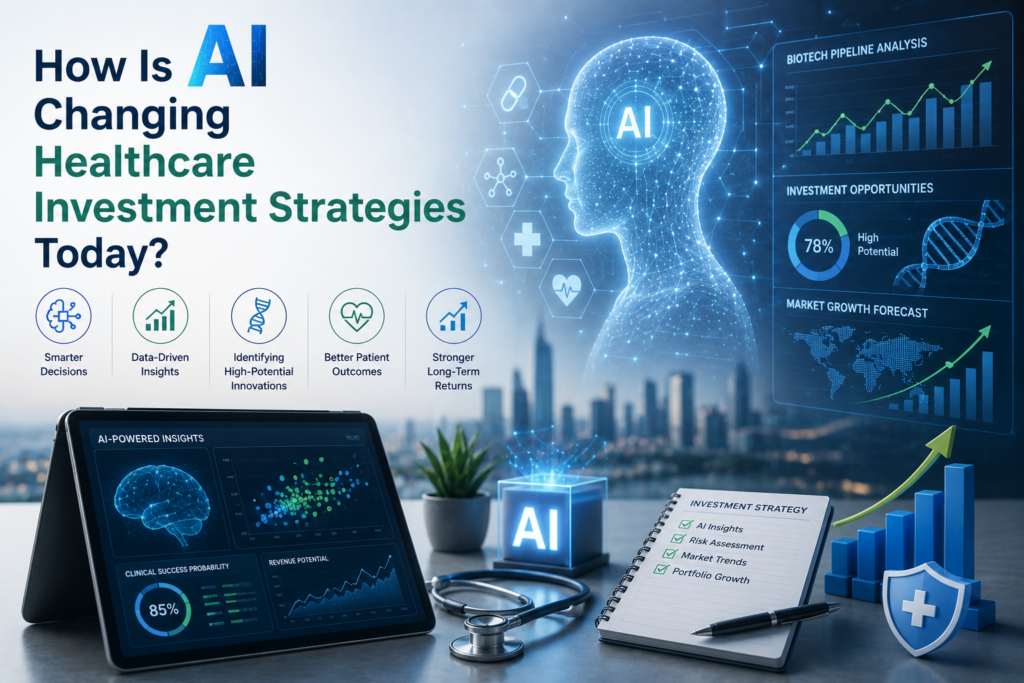

Healthcare investing has always been shaped by science, regulation, and long development cycles. But artificial intelligence is starting to change how investors think, where they place capital, and how fast they expect returns. What used to take decades of research and trial-and-error is now being compressed into faster, data-driven decision-making.
So the real question is not whether AI is affecting healthcare investment. It clearly is. The real question is how deep that change goes and what it means for investors today.
A Shift From Traditional Pharma To Data-First Healthcare
For a long time, healthcare investment focused heavily on pharmaceuticals, medical devices, and hospital infrastructure. These areas still matter, but AI healthcare investment is pushing capital toward a new category: data-driven healthcare companies.
These companies are not just building drugs or devices. They are building systems that learn from massive datasets. That includes patient records, genetic data, imaging scans, and real-world health outcomes.
Investors are now looking at:
- AI-based diagnostics tools
- Predictive healthcare platforms
- Genomics and personalized medicine companies
- Digital health infrastructure powered by machine learning
The core shift is simple. Instead of betting only on physical treatments, investors are now betting on intelligence systems that improve how treatment is discovered, delivered, and monitored.
Personalized Medicine Is Attracting Long-Term Capital
Another major area influenced by AI is personalized medicine. Instead of one-size-fits-all treatments, healthcare is moving toward solutions tailored to individual genetics and health data.
Companies working in genomics, predictive risk scoring, and precision treatment planning are gaining attention from investors.
This is where AI becomes especially powerful. It can analyze complex biological data that humans cannot easily process at scale. That includes:
- Genetic sequencing
- Lifestyle and environmental data
- Medical imaging patterns
- Long-term patient outcomes
This combination allows healthcare providers to move from reactive treatment to preventive care.
From an investment point of view, this is not just a medical improvement. It is a structural shift in how healthcare systems operate. Investors see long-term value in platforms that can sit at the center of personalized healthcare ecosystems.
Investment Decisions Are Becoming More Data-driven
AI is not only changing healthcare companies. It is also changing how investors make decisions.
Venture capital firms, private equity groups, and institutional investors are increasingly using AI tools to:
- Screen startup pipelines
- Evaluate clinical trial data
- Analyze market demand for health technologies
- Predict regulatory outcomes
- Assess long-term scalability
Instead of relying only on expert intuition, investors now combine human judgment with machine-driven analysis.
This leads to faster filtering of opportunities and more focus on companies with strong data signals. It also reduces the chance of missing patterns that are not obvious through traditional analysis.
New Risks Are Emerging Alongside New Opportunities
While AI opens up strong opportunities in healthcare investment, it also introduces new risks that investors cannot ignore.
One major concern is data quality. AI systems are only as good as the data they are trained on. Incomplete or biased datasets can lead to poor predictions and flawed healthcare solutions.
Regulation is another challenge. Healthcare is one of the most heavily regulated industries in the world. AI-driven tools often raise questions about patient privacy, clinical safety, and approval standards.
There is also the risk of overvaluation. As AI healthcare becomes a popular investment theme, some startups may attract capital based more on hype than proven results.
Investors today need to balance excitement with caution. Strong due diligence is more important than ever.
The Rise of AI-focused Healthcare Investment Groups
A noticeable trend is the emergence of investment groups that focus specifically on AI and healthcare convergence. These firms are not just funding companies. They are actively shaping ecosystems where AI, biotechnology, and healthcare infrastructure come together.
They typically:
- Invest in early-stage AI healthcare startups
- Partner with research institutions
- Support clinical validation processes
- Help companies scale across regions
This type of focused investment approach is becoming more common as healthcare innovation becomes more complex and specialized.
How Healthcare Investors Are Adapting to AI
Well, in today’s time, the right healthcare investor is changing how they evaluate opportunities because AI is reshaping the entire industry. Instead of focusing only on traditional metrics like market size and clinical outcomes, investors are now prioritizing data quality, algorithm strength, and scalability of AI systems.
Many healthcare investors now look for startups that combine medical expertise with strong machine learning capabilities. The goal is not just to fund treatments but to support platforms that can continuously learn and improve over time.
Due diligence has also become more technical. Investors increasingly analyze datasets, model performance, and real-world validation before making decisions. This shift requires a deeper understanding of both healthcare and technology.
At the same time, healthcare investors are forming partnerships with research institutions and AI labs to reduce risk and improve visibility into early-stage innovation.
Conclusion
AI is changing healthcare investment by speeding up research, improving decision-making, and shifting focus toward data-driven medicine. It is creating new opportunities in drug discovery, personalized treatment, and digital health platforms.
At the same time, it introduces new risks around regulation, data quality, and valuation discipline.
For investors, the key is not just to follow the AI trend but to understand how deeply it is embedded into the future of healthcare itself.
