
Most businesses believe their documents are safe because they are stored digitally. That assumption does not hold up under scrutiny. Files sitting in shared drives or cloud folders may look organized, but they often lack the structure and legal safeguards required for compliance. This is exactly where Qualified Electronic Archiving becomes critical.
Organizations today handle sensitive records daily, from financial transactions to employee data. Without a compliant archiving framework, these documents can lose integrity over time or fail to meet regulatory standards. According to International Data Corporation, the global datasphere is projected to reach 175 zettabytes, making proper data governance a serious operational priority.
This is not about storage anymore. It is about proving that your data is authentic, unchanged, and accessible when it matters most.
Beyond Storage: Building Trust Into Every Document
There is a major difference between saving files and preserving records. Qualified Electronic Archiving focuses on trust. Every document stored within such a system must remain verifiable, secure, and legally valid over time.
This is achieved through mechanisms like digital signatures, secure timestamps, and encryption protocols. Standards developed by European Telecommunications Standards Institute define how these systems ensure document authenticity and integrity. Once a file is archived, it cannot be altered without leaving a trace.
Now think about the cost of getting this wrong. Gartner reported that poor data management costs organizations an average of $12.9 million per year. That includes compliance failures, inefficiencies, and risk exposure.
A properly implemented archiving system flips that narrative. It creates a single source of truth where every document can stand up to audits, disputes, or regulatory checks without hesitation.
Why Compliance Pressure Is Reshaping Archiving Strategies
Regulations have tightened, and businesses are feeling it. Laws like the General Data Protection Regulation have introduced strict requirements around how data is stored, accessed, and protected. Organizations are no longer judged only on what data they collect, but on how responsibly they manage it over time.
At the same time, internal inefficiencies are becoming harder to ignore. McKinsey & Company found that employees spend nearly 20 percent of their time searching for information. That is a massive drain on productivity.
Here is a practical scenario. A healthcare provider struggling with audit delays implemented a qualified archiving system. Within months, document retrieval times dropped significantly, and compliance reporting became structured and predictable. What used to take hours started taking minutes.
The shift is clear. Businesses are moving toward systems that reduce risk, improve efficiency, and align with regulatory expectations without constant manual intervention.
What Separates a Reliable Archiving System From the Rest
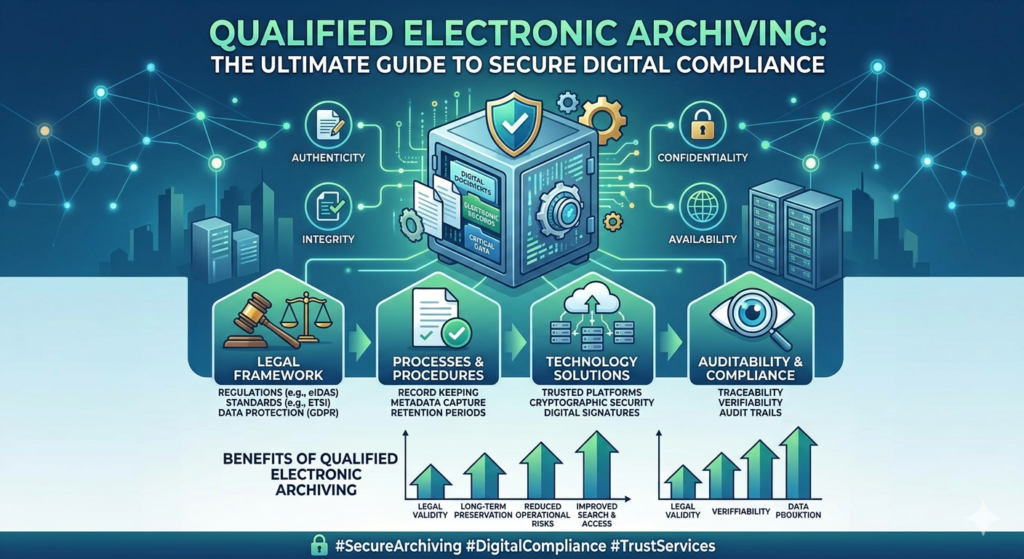
Not every solution claiming compliance actually delivers it. A true Qualified Electronic Archiving system must meet specific technical and operational standards. This is where a lot of businesses get tripped up. A platform may offer storage, search, and basic access controls, but that does not automatically make it suitable for regulated recordkeeping. Real archiving is about preserving trust in the document over time, not just keeping a copy of it somewhere.
Immutability is non-negotiable. Once a document is archived, it must remain unchanged. Any attempt to modify it should be recorded and visible. This protects the original version and helps prove that the file has not been tampered with after storage. In regulated environments, that kind of assurance matters a lot. If a document can be quietly edited after the fact, its credibility falls apart.
Traceability is equally important. Every interaction with a document should be logged, creating a clear audit trail. This ensures accountability across teams. It should be possible to see who accessed a file, when they accessed it, what action they took, and whether any permissions were changed. That level of visibility becomes critical during audits, internal investigations, or legal disputes. Without it, businesses are left guessing, and guessing does not hold up well under pressure.
Long-term accessibility is another key factor. Documents must remain readable and usable years down the line, regardless of evolving file formats or technologies. That sounds simple, but it is one of the most overlooked parts of an archiving strategy. File types become outdated. Software changes. Storage platforms get replaced. A reliable system plans for that by preserving documents in stable formats and maintaining metadata so records can still be retrieved and understood in the future.
Then comes automation. Manual processes introduce risk and slow everything down. Modern archiving systems automate classification, retention policies, and indexing, making compliance consistent and scalable. Instead of depending on staff to decide where a document belongs or how long it should be kept, the system applies rules automatically based on document type, source, or business process. That reduces human error and creates a far more dependable framework.
Security also plays a major role in separating strong systems from weak ones. Sensitive documents should be protected with role-based access, encryption, and controls that limit who can view, export, or manage records. This matters not only for privacy, but also for compliance. A business cannot claim secure archiving if confidential records are easy to access or download without oversight.
Integration is another marker of a mature system. Archiving should not sit off to the side as an isolated function. The strongest platforms connect directly with document management systems, ERP platforms, email environments, and business applications so records can be archived at the right moment without extra handling. When archiving is built into the workflow, compliance becomes part of normal operations instead of a cleanup job after the fact.
Retention and disposal controls matter too. A reliable system should not only keep documents safely, but also enforce how long they are retained and when they should be deleted. Keeping records forever may sound safe, but in many cases it creates legal and operational problems. Strong archiving platforms support retention schedules, legal holds, and defensible deletion so businesses can manage records throughout their full lifecycle.
Scalability cannot be ignored either. As document volumes grow, the system should continue performing without creating delays, confusion, or added administrative burden. What works for a few thousand records may collapse under millions if the platform was not designed for long-term growth. Reliable archiving systems are built to handle expansion without sacrificing control or performance.
Here is the honest take. If your system depends heavily on manual uploads, naming conventions, or human memory, it is already exposing your business to unnecessary risk. A compliant archiving strategy should not rely on people remembering every step correctly. It should rely on a system designed to preserve accuracy, enforce policy, and maintain trust in every record from day one.
The Strategic Value of Getting Archiving Right
When done properly, archiving stops being a backend function and starts becoming a strategic asset. Qualified Electronic Archiving allows businesses to operate with confidence, knowing that their records are accurate, secure, and audit-ready at all times.
It also improves decision-making. When data is structured and accessible, teams can retrieve insights faster and act with clarity. There is no second-guessing whether a document is the latest version or if it has been altered.
Security improves as well. With built-in encryption and controlled access, sensitive information remains protected against both internal misuse and external threats.
This is where traditional approaches fall apart. Basic storage solutions were never designed to meet modern compliance demands. They store files, but they do not protect their integrity or prove their authenticity.
Closing Thoughts
The digital world moves fast, but compliance moves even faster. Businesses that fail to adapt often realize the gaps only when it is too late. Qualified Electronic Archiving provides a structured way to stay ahead, ensuring that every document is secure, verifiable, and ready when needed.
The risks of ignoring proper archiving are not theoretical. They show up in failed audits, lost data, and operational chaos. On the other hand, a well-implemented system creates stability, efficiency, and trust across the organization.
At the end of the day, this comes down to control. Either your documents are working for you, or they are quietly becoming a liability.