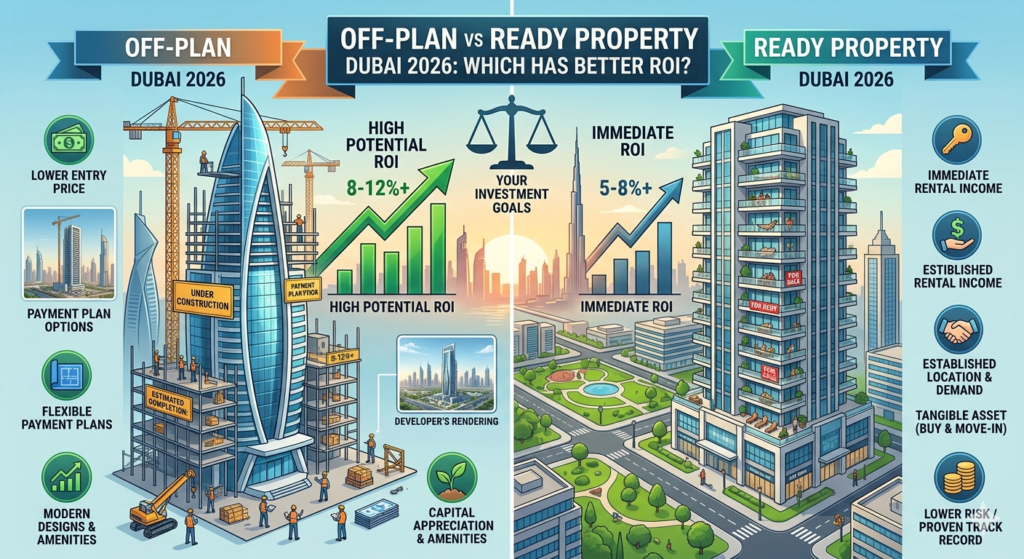

Every investor landing in Dubai faces the same fork in the road. One path leads to gleaming towers still under construction, flexible payment plans, and the promise of early-entry gains. The other leads to a property you can walk into, rent out, and start earning from tomorrow. In 2026, both paths are delivering real returns. But they deliver them differently, on different timelines, with different risk profiles. Whether you are chasing rental income, capital growth, or some blend of both, the choice between off-plan and ready property in Dubai carries real financial consequences.
How Dubai’s Property Market Looks Heading Into 2026 ?
The numbers behind Dubai’s market remain striking. According to Dubai Land Department data, real estate transactions reached AED 761 billion in 2024, a 20 percent increase from 2023. That momentum carried into 2025 without pause. By Q3 2025, transaction volumes broke records typically reserved for cooler months, and Property Monitor’s Dynamic Price Index logged its 56th consecutive month of positive growth since the current cycle began.
Off-plan sales now account for roughly 64 to 65 percent of all residential transactions, according to DLD data compiled by DXB Analytics. That figure stood at 54 percent in 2024. Developers have powered this shift through flexible payment structures, with some schemes deferring 50 to 60 percent of the purchase price to post-handover. For investors wanting Real estate market exposure without deploying full capital upfront, that structure has proved compelling. Knight Frank projects price appreciation moderating to 3 to 5 percent in prime segments through 2026, while Cushman and Wakefield Core forecasts mid-single-digit growth of 5 to 8 percent across the broader market.
Ready properties hold steady at 35 to 40 percent of annual transactions, driven primarily by end-users and yield-focused investors. Two distinct buyer profiles are choosing two distinct products. Understanding which one matches your financial goals is where the analysis starts.
The Off-Plan Case: Capital Appreciation Before You Hold the Keys
Off-plan in Dubai has one central attraction: entry price. Off-plan units typically launch at 15 to 30 percent below comparable ready properties at the time of sale, according to market data from Peace Homes Development and Pearlshire. By handover, early buyers in well-located projects have historically achieved capital appreciation of 15 to 25 percent. In strong market phases, those gains have stretched to 30 percent or more.
The data from early 2026 confirms the appreciation journey remains intact. DLD transaction records analysed by DXB Analytics show off-plan properties trading at an average of AED 2,149 per square foot against AED 1,663 per square foot for ready properties as of January 2026. That is a 29 percent premium at or near handover, which reflects what early buyers captured during the construction period. S&P Global noted in 2025 that off-plan prices rose approximately 5 percent from early in the year, while ready-market prices largely stabilised.
For investors entering a newly launched project today, the appreciation window runs from purchase to completion, spanning roughly 18 to 36 months depending on scale and developer. In infrastructure-driven growth zones like Dubai South, Dubai Creek Harbour, and Arjan, analysts have identified potential completion gains in the 10 to 15 percent range. Off-plan in Q1 2025 accounted for 68.9 percent of total residential transactions, according to DLD data compiled by Peace Homes Development, which confirms this remains the dominant choice among active buyers.
The limitation is straightforward. You earn no rental income during the construction period. If handover slips, which does happen even with RERA-registered developers, your income window narrows. Off-plan ROI is structured around capital appreciation with zero day-one yield. For investors who need current cash flow, that gap matters.
The Ready Property Case: Yield That Starts Working Immediately
Ready properties do not promise dramatic pre-completion price jumps. What they deliver is predictable, measurable income from the day the sale completes. Rental yields across Dubai averaged 6.7 to 7 percent gross in 2025, with apartments outperforming villas at around 7.1 to 7.3 percent, according to DXB Interact and REIDIN data. That is before income tax, which in Dubai does not exist.
In high-demand mid-market communities, the numbers improve further. International City and Dubai Investment Park recorded gross yields of 9 to 10 percent, according to Bayut’s H1 2025 report. Jumeirah Village Circle and Dubai Silicon Oasis consistently deliver 7 to 9 percent for well-priced one and two-bedroom apartments. Against London and New York, where gross yields of 2 to 4 percent are common, those figures continue to attract international capital. Dubai’s citywide average has remained above 6.7 percent throughout 2025, reinforced by rental growth of 8.5 to 9 percent year-on-year for apartments as of mid-2025, according to DXB Interact.
Net yield is the figure that actually determines real profit. With service charges, chiller fees, and vacancy periods factored in, net yields typically run 1 to 2 percentage points below gross, according to NOVVI Properties. A JVC apartment grossing 8 percent may net closer to 6 to 6.5 percent annually. That still outperforms most comparable markets. For investors who want to see this modelled across multiple communities and holding periods, this off-plan vs ready property comparison for Dubai investors lays out the yield differences across unit types and location tiers.
Ready properties also carry a certainty premium that off-plan cannot match. You inspect the unit, assess the finish quality, evaluate the surrounding community, and make a decision based on observable facts rather than architectural renderings. For investors relying on rental income to service financing or cover living costs, that certainty is not a luxury. It is part of the investment calculation.
Matching the Option to Your Investor Profile
The off-plan versus ready question is not a debate about which is objectively better. It is a question about what you are optimising for and over what timeframe.
If you have capital to deploy over a 2 to 3 year horizon and do not need immediate income, off-plan in a growth-corridor community gives you the strongest chance at above-market returns. Entry pricing is lower. Payment plans spread your exposure across the construction period. And in projects from developers with clean delivery records, the gap between launch price and handover value can be significant. Dubai South, Meydan, and Dubai Islands have been flagged by multiple agencies as areas where early-stage off-plan buyers are still finding genuine price gaps relative to projected completion values.
If you are building an income-generating portfolio, need cash flow from day one, or want to eliminate execution risk, ready property is the cleaner choice. In communities where supply is constrained, such as parts of Business Bay, JVC, and Dubai Hills, rental demand stays firm and vacancy rates are low. An investor buying a well-priced, chiller-free apartment in a high-demand community can start generating net yield above 6 percent from month one.
A third option exists and is worth naming. Buying an off-plan unit at 70 to 80 percent construction completion gives you some of the appreciation upside from the remaining construction period, a shorter wait before rental income begins, and meaningfully lower risk of significant delay. These opportunities are narrower and require sharper sourcing. But for investors who want to blend both strategies, near-completion off-plan is the middle ground worth exploring.
Dubai in 2026 gives investors genuine options. Off-plan delivers capital appreciation potential, flexible payment structures, and early entry into growing communities. Ready property delivers income from day one, transparency, and lower execution risk. The better choice depends entirely on how you invest: over what timeline, with what cash flow requirements, and with what tolerance for construction-phase uncertainty. Both strategies are producing returns. The question is which one fits the way you want to build.
About the Author
Naina Singh covers Dubai real estate for investors and expats. With deep knowledge of the UAE property market, he writes about off-plan strategies, rental yields, and Golden Visa pathways at DubaiPropertyInsight.com.