
Reality Labs and VR Investments:
Meta’s Reality Labs division which encompasses its virtual/augmented reality initiatives has absorbed massive investment. Meta produces the Oculus/Meta Quest VR headsets, Ray-Ban smart glasses, and VR social platforms like Horizon Worlds. The company has repeatedly emphasized the “metaverse” vision – an immersive digital world – as a future cornerstone of social networking.
Alongside hardware, Meta has funded VR game studios and user-generated-world platforms. This push has been strategic: by rebranding as Meta in 2021, CEO Mark Zuckerberg signaled a shift toward immersive experiences. In practice, most current revenues still come from traditional ads on Facebook, Instagram and WhatsApp.
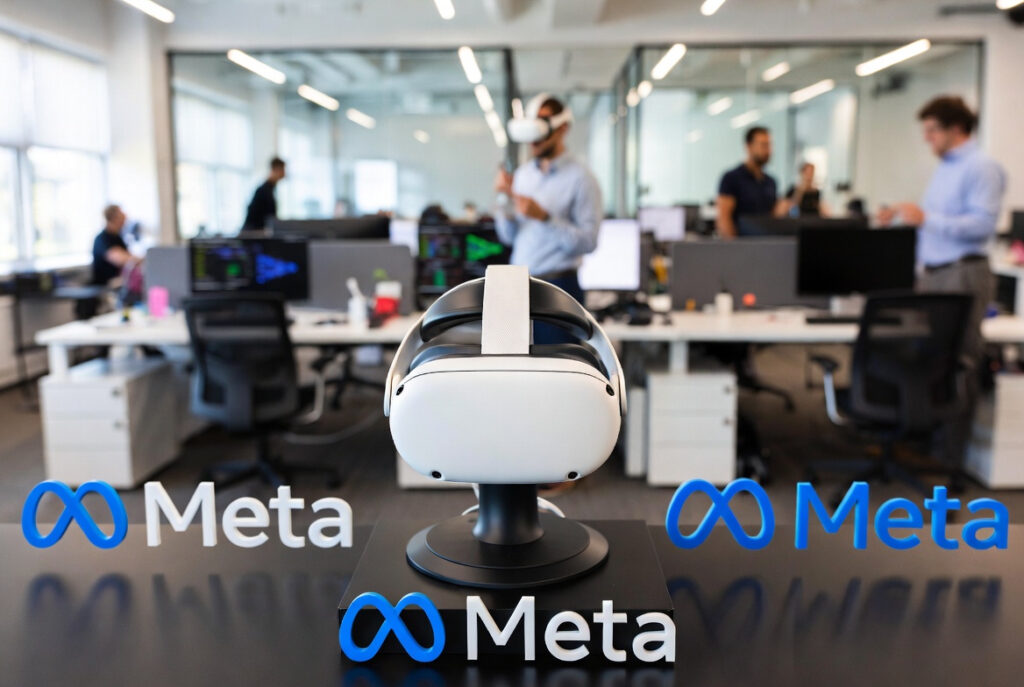
Meta’s Reality Labs includes the Quest series of VR headsets and AR glasses. Despite high hopes, adoption has been slow Horizon Worlds had only a few hundred thousand monthly users by 2022.
Strategic Rationale:
Meta’s VR/metaverse investment has been pitched as long-term. The company believes that virtual/augmented reality can evolve social connections, commerce and entertainment beyond current 2D apps. Zuckerberg has said Meta is “directing most of [RL] investment towards glasses and wearables and making Horizon a massive success on mobile”. In other words, Meta is refocusing on AR devices and integrating VR experiences with phones, while still pursuing the full VR ecosystem. Meta argues that early losses are justified by building first-mover advantage. Indeed, Meta claims to have an early lead in AR – its Ray-Ban smart glasses saw sales more than triple in 2025 and it dominates VR hardware share.
Challenges Faced: Despite deep investment, Reality Labs has struggled with multiple headwinds. Key challenges include:
- Technical and cost barriers. High-end VR headsets remain expensive ($300–$1,500) and bulky. Even improved models (e.g. Quest 3) require compromises in comfort and battery life. These factors limit consumer uptake.
- Niche adoption. User demand has been limited. Meta itself reported about 300,000 users on Horizon Worlds in early 2022, but news reports soon showed that figure had fallen to under 200,000 monthly users. VR remains largely a gaming niche, not a mass social platform.
- Content and monetization. Early VR experiences have been criticized as underwhelming (buggy environments, basic avatars). Horizon Worlds, for example, has been called “soulless” and struggled to sustain users. Without a proven ad platform or virtual commerce model, Reality Labs relies on hardware sales and content subsidies.
- Competitive pressure. New entrants challenge Meta’s vision. Apple’s Vision Pro (launched 2024) set high expectations for mixed reality, while Snap and others are exploring AR in social media. Even so, Meta’s Quest lineup still dominates headset sales, but the competition underscores that VR is a contested future.
Financial Impact (2025):
Meta’s latest earnings confirm the scale of the losses. In FY2025 Reality Labs lost $19.193 billion (vs. $17.729B in 2024). Q4 alone saw a $6.02B operating loss on just $955M in revenue. By contrast, Meta’s Family of Apps earned about 20× that revenue for the year. Notably, RL’s $2.2B in 2025 sales were dwarfed by its costs. Financial statements make clear Reality Labs is a strategic loss leader; Zuckerberg acknowledges it is “deeply unprofitable in the near term”.
Challenges and losses are not surprising. As Moneycontrol reports, these results have come despite Meta cutting about 10% of its Reality Labs workforce and shuttering some VR game studios. Even Meta’s virtual “Workrooms” office app has been discontinued, underscoring difficulty finding mainstream use cases. In short, Reality Labs has remained “one of the most expensive bets in tech, with no clear path to profitability in sight”.
2026 Outlook:
Meta expects 2026 will see continued heavy investment. On its Q4 call, Zuckerberg said Reality Labs losses “this year [2026] will be similar to last year” and that 2026 is “likely to be the peak” before losses moderate. The official guidance implies another year of ~$19–20B in VR losses. Analysts note, however, that budgets are shifting.
Bloomberg and Reuters report Meta plans up to 30% cuts in metaverse spending for 2026, reflecting more cautious resource allocation. Huber Research’s Craig Huber called this adjustment “a smart move, just late,” aligning costs with a less optimistic revenue outlook. In sum, experts foresee 2026 as a pivot point: Reality Labs will still burn cash, but Meta is curbing outlays and refocusing on AI-driven growth.
Implications for Social Media and Advertising:
Meta’s pivot away from an all-in VR vision has broader industry impact. For social media professionals, the key takeaway is that immersive VR isn’t yet a lucrative ad environment. Meta’s core platforms remain the cash cow: digital ads on Facebook, Instagram and WhatsApp continue to grow, and AI-powered features will drive future engagement. By contrast, VR/Metaverse applications still account for a negligible share of users and ad revenue. As Reuters notes, Meta “has struggled to sell its vision of an immersive metaverse beyond the niche of the gaming community”. This suggests marketers should continue focusing budgets on proven channels.
Looking ahead, Meta’s renewed emphasis on AR glasses could signal new ad formats if adoption picks up Zuckerberg pointed out that Meta’s smart glasses are gaining traction. Meanwhile, other platforms may adapt: competitors like Snap or Apple (with Vision Pro) are exploring their own mixed-reality ads. Overall, 2026 may see Meta and its peers double down on AI-driven targeting and content on existing apps, while treating VR/metaverse marketing experiments as far-term bets. Advertising strategies will likely emphasize short-term engagement metrics and new AI features on social apps, rather than immersive VR placements.
Meta’s Reality Labs is a massive investment financed by its profitable ad businesses. The $19.1B loss in 2025 underscores the scale of the bet, but even as losses peak, Meta is trimming its metaverse sails. For social media and marketing professionals, this means staying focused on core social apps and emerging AI tools. The metaverse remains a long-term vision, but its commercial impact will be measured in years, not months.