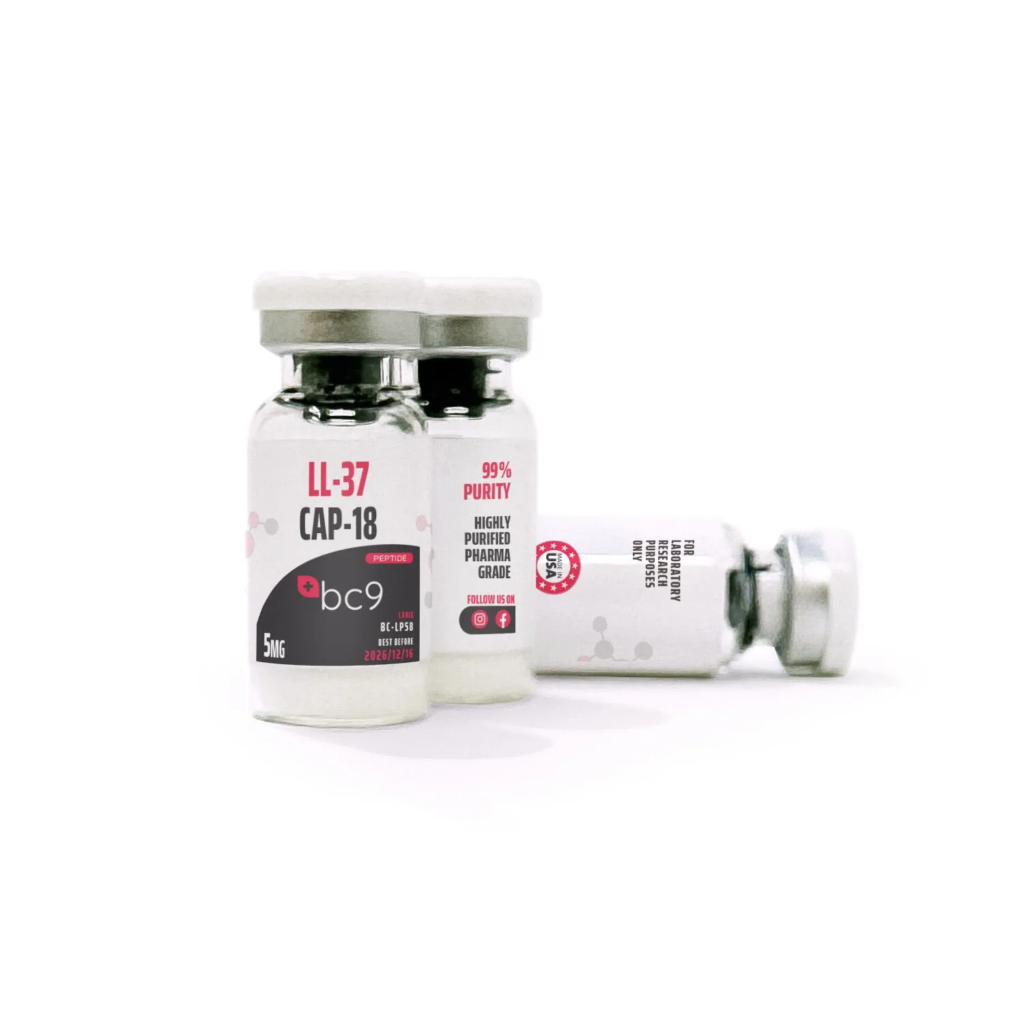

The LL-37 peptide is a cationic antimicrobial peptide and the only human member of the cathelicidin family. Encoded by the CAMP gene, LL-37 plays a central role in innate immunity, host defense modulation, inflammatory signaling, and tissue repair. Beyond its antimicrobial activity, LL-37 peptide functions as a potent immunomodulator, orchestrating cellular communication between epithelial barriers, leukocytes, and resident stromal cells.
This comprehensive analysis details the molecular structure, biochemical properties, immune signaling pathways, receptor interactions, and physiological implications of LL-37 peptide across multiple organ systems.
Molecular Origin and Biosynthesis of LL-37 Peptide
LL-37 peptide is derived from the precursor protein hCAP-18 (human cationic antimicrobial protein of 18 kDa). The CAMP gene located on chromosome 3 encodes hCAP-18, which is proteolytically cleaved by serine proteases such as proteinase 3 in neutrophils.
Processing Pathway:
- CAMP gene transcription
- Translation of hCAP-18 precursor
- Proteolytic cleavage at the C-terminal domain
- Release of active 37–amino acid LL-37 peptide
The peptide begins with two leucine residues (LL), hence the designation LL-37.
Structural Characteristics of LL-37 Peptide
LL-37 peptide is composed of 37 amino acids and exhibits an amphipathic α-helical structure under physiological conditions. In aqueous environments, it remains partially unstructured, but upon contact with lipid membranes, it adopts a stable α-helix.
Structural Features:
- Length: 37 amino acids
- Net positive charge: +6
- Amphipathic α-helical conformation
- Molecular weight: ~4.5 kDa
- Strong affinity for negatively charged membranes
The cationic nature enables LL-37 peptide to selectively interact with microbial membranes rich in anionic phospholipids while sparing host cell membranes, which are largely zwitterionic.
Antimicrobial Mechanisms of LL-37 Peptide
LL-37 peptide exerts broad-spectrum antimicrobial activity against:
- Gram-positive bacteria
- Gram-negative bacteria
- Fungi
- Enveloped viruses
Membrane Disruption Model
LL-37 peptide binds to negatively charged bacterial membranes via electrostatic interactions. Upon accumulation, it inserts into the lipid bilayer, forming transient pores or causing membrane destabilization.
Mechanistic pathways include:
- Carpet model membrane disruption
- Toroidal pore formation
- Membrane thinning and depolarization
The result is osmotic imbalance, cytoplasmic leakage, and microbial cell death.
Immunomodulatory Functions of LL-37 Peptide
LL-37 peptide extends beyond antimicrobial defense and acts as a key immune signaling mediator.
Chemotactic Activity
LL-37 peptide recruits immune cells through interaction with formyl peptide receptor-like 1 (FPRL1/FPR2), promoting:
- Neutrophil migration
- Monocyte recruitment
- T-cell chemotaxis
- Dendritic cell activation
Cytokine Regulation
LL-37 peptide modulates cytokine production depending on the inflammatory context:
- Induces IL-8 secretion in epithelial cells
- Enhances TNF-α production in macrophages
- Suppresses excessive TLR-mediated inflammation under specific conditions
LL-37 Peptide and Toll-Like Receptor Signaling
A defining feature of LL-37 peptide is its ability to regulate Toll-like receptor (TLR) signaling.
DNA/RNA Complex Formation
LL-37 peptide binds extracellular self-DNA and microbial nucleic acids, forming stable complexes that:
- Facilitate uptake into plasmacytoid dendritic cells
- Activate TLR9 (DNA)
- Activate TLR7/8 (RNA)
This mechanism is critical in antiviral immunity but may contribute to autoimmune disorders when dysregulated.
Role of LL-37 Peptide in Skin Immunity
In the epidermis, LL-37 peptide is produced by keratinocytes and upregulated by vitamin D signaling. It is essential for maintaining barrier integrity and protecting against microbial colonization.
Functions in Cutaneous Immunity:
- Direct antimicrobial action
- Enhancement of wound re-epithelialization
- Promotion of angiogenesis
- Modulation of inflammatory cascades
Dysregulated expression of LL-37 peptide has been associated with inflammatory skin disorders such as psoriasis, where excessive DNA-LL-37 complexes amplify interferon responses.
LL-37 Peptide in Respiratory and Gastrointestinal Defense
Respiratory Tract
Airway epithelial cells secrete LL-37 peptide in response to infection. It enhances mucosal defense through:
- Neutralization of bacterial endotoxins
- Inhibition of biofilm formation
- Regulation of neutrophilic inflammation
Gastrointestinal System
Within the gut, LL-37 peptide contributes to:
- Microbiota balance
- Protection against enteric pathogens
- Epithelial restitution after injury
Its expression is influenced by microbial metabolites and vitamin D levels.
Angiogenesis and Tissue Repair Functions
LL-37 peptide promotes endothelial cell proliferation and vascular remodeling. It stimulates:
- VEGF production
- Endothelial migration
- Matrix metalloproteinase activation
These properties position LL-37 peptide as a mediator of wound healing and regenerative signaling.
Antiviral Properties of LL-37 Peptide
LL-37 peptide disrupts viral envelopes and interferes with viral entry mechanisms. It has demonstrated activity against:
- Influenza viruses
- Herpesviruses
- Coronaviruses (in vitro models)
Mechanisms include:
- Direct viral membrane disruption
- Inhibition of viral replication
- Enhancement of interferon-mediated antiviral states
Regulation of LL-37 Peptide Expression
Expression of LL-37 peptide is tightly regulated by:
- Vitamin D receptor activation
- NF-κB signaling
- Microbial exposure
- Inflammatory cytokines
Vitamin D response elements (VDREs) in the CAMP promoter region link endocrine regulation to innate immune activation.
LL-37 Peptide in Autoimmunity and Chronic Inflammation
Excessive LL-37 peptide activity can contribute to pathological immune activation.
Mechanistic Contributions:
- Stabilization of self-DNA in extracellular space
- Amplification of plasmacytoid dendritic cell activation
- Sustained interferon signaling
- Chronic inflammatory cascade propagation
Such dysregulation is implicated in psoriasis and systemic autoimmune conditions.
Biochemical Properties Summary
| Property | Description |
| Family | Cathelicidin |
| Length | 37 amino acids |
| Charge | Cationic (+6) |
| Structure | Amphipathic α-helix |
| Primary Role | Antimicrobial & immunomodulatory |
| Expression Sites | Skin, neutrophils, airway epithelium, GI tract |
Clinical and Research Implications of LL-37 Peptide
LL-37 peptide represents a central mediator at the interface of innate and adaptive immunity. Its dual antimicrobial and immunoregulatory capabilities make it a key molecule in host defense biology.
Ongoing investigations focus on:
- Synthetic LL-37 peptide analogs
- Controlled immunomodulation
- Barrier tissue therapeutics
- Anti-biofilm applications
- Immune signaling modulation strategies
Conclusion
The LL-37 peptide is a structurally dynamic, multifunctional cathelicidin that integrates membrane disruption, immune cell recruitment, nucleic acid sensing, and inflammatory modulation into a unified defense mechanism. Its amphipathic α-helical architecture underpins direct antimicrobial action, while receptor-mediated signaling enables precise orchestration of innate immunity.
Through coordinated antimicrobial activity, Toll-like receptor signaling regulation, chemotactic control, and tissue repair promotion, LL-37 peptide functions as a central regulator of human host defense and immune communication.