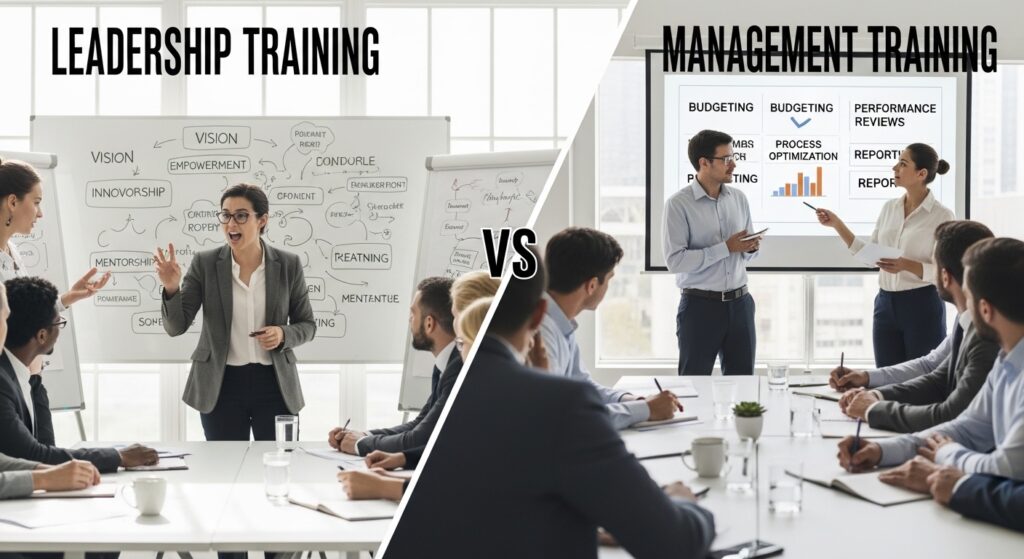

Strong teams rarely fail because of a lack of talent. They struggle when direction is unclear or execution falls apart. That is where leadership and management training come in. These two are often used interchangeably, but they serve very different purposes.
If you are deciding which training to invest in, or trying to understand how both shape performance, this guide breaks it down in clear, practical terms.
What Is Leadership Training?
Leadership training focuses on influence, vision, and people development. It helps individuals guide teams, inspire action, and make decisions that shape long-term outcomes. Instead of teaching tasks, leadership training develops mindset, behaviour, and the ability to lead others effectively.
A leader is not just someone who gives instructions. A leader creates direction, builds trust, and motivates people to perform at their best even in uncertain situations.
Key areas covered:
- Strategic thinking and decision-making
- Emotional intelligence and self-awareness
- Communication and influence
- Vision setting and goal alignment
- Change management and innovation
Leadership training is especially important in environments where adaptability, collaboration, and forward thinking are required. It prepares individuals to step beyond daily responsibilities and contribute to the bigger picture.
What Is Management Training?
Management training is about execution, structure, and efficiency. It equips individuals with the skills needed to organise work, manage resources, and ensure tasks are completed on time. It focuses on systems, processes, and accountability.
Managers are responsible for turning plans into results. They ensure that workflows run smoothly, deadlines are met, and teams stay aligned with operational goals.
Key areas covered:
- Planning and task allocation
- Performance monitoring
- Time and resource management
- Problem-solving and operations
- Team coordination
Management training is essential for maintaining consistency and ensuring that business operations function without disruption.
Leadership vs Management Training: Core Differences
Focus
- Leadership training: People, vision, and growth
- Management training: Tasks, processes, and execution
Purpose
- Leadership: Drives change and long-term direction
- Management: Maintains stability and daily operations
Skill Type
- Leadership: Soft skills (communication, empathy, influence)
- Management: Practical skills (planning, organising, tracking)
Time Horizon
- Leadership: Future-focused
- Management: Present-focused
Approach
- Leadership: Inspires and empowers
- Management: Directs and controls
Why Businesses Need Both
High-performing organisations do not choose between leadership and management. They combine both to create balance between vision and execution.
A strong leader without management skills may inspire a team but fail to deliver results due to lack of structure. On the other hand, a strong manager without leadership skills may deliver results but struggle to motivate, retain, or develop people.
Balanced teams benefit from:
- Clear direction (leadership)
- Structured execution (management)
- Higher engagement and accountability
- Better long-term growth and stability
When to Choose Leadership Training
Leadership training is most effective when the goal is to build influence, strengthen direction, and prepare individuals for greater responsibility. It supports those who are expected to guide teams, make strategic decisions, and lead through change rather than simply manage tasks.
Ideal for:
- Senior professionals and executives
- High-potential employees
- Team leaders transitioning into strategic roles
- Organisations undergoing change
Common outcomes:
- Improved decision-making
- Stronger team engagement
- Better adaptability to change
- Clear organisational vision
When to Choose Management Training
Management training is the right choice when the focus is on improving performance, structure, and day-to-day execution. It helps individuals organise work more effectively, manage teams with clarity, and ensure tasks are completed efficiently and consistently.
Ideal for:
- New managers or supervisors
- Team leads handling daily operations
- Businesses facing productivity issues
- Growing teams needing structure
Common outcomes:
- Better task execution
- Improved time and resource use
- Increased accountability
- Reduced operational errors
Leadership vs Management Training: Which Is Better?
Strong teams rarely fail because of a lack of talent. They struggle when direction is unclear or execution falls apart. That is where leadership and management training come in. These two are often used interchangeably, but they serve very different purposes in a business environment.
If you are deciding which training to invest in, or trying to understand how both shape performance, this guide breaks it down in clear, practical terms so you can make the right decision based on your needs.
How to Choose the Right Training Program
Choosing the right training program starts with understanding your current challenges and what you want to improve. Whether the issue is team alignment, performance gaps, or lack of structure, the right program should directly address those needs and deliver practical, measurable results.
Ask yourself:
- Are you struggling with people or processes?
- Do you need better direction or better execution?
- Is your goal growth or efficiency?
Look for programs that offer:
- Real-world case studies
- Practical application, not just theory
- Measurable outcomes
- Ongoing support or coaching
Conclusion
Leadership training and management training serve different but equally important roles within any organisation. Leadership is about vision, influence, and long-term growth. Management is about structure, execution, and consistency. You do not need to choose one over the other. The most effective professionals develop both skill sets and apply them based on the situation.
Understanding the difference between leadership and management training is the first step toward building stronger teams, improving performance, and achieving sustainable success.
Effective organisations recognise that investing in both leadership and management training creates a stronger foundation for long-term success. By developing individuals who can both inspire and execute, businesses position themselves to adapt quickly, maintain consistency, and build teams that are not only productive but also engaged and aligned with shared goals.