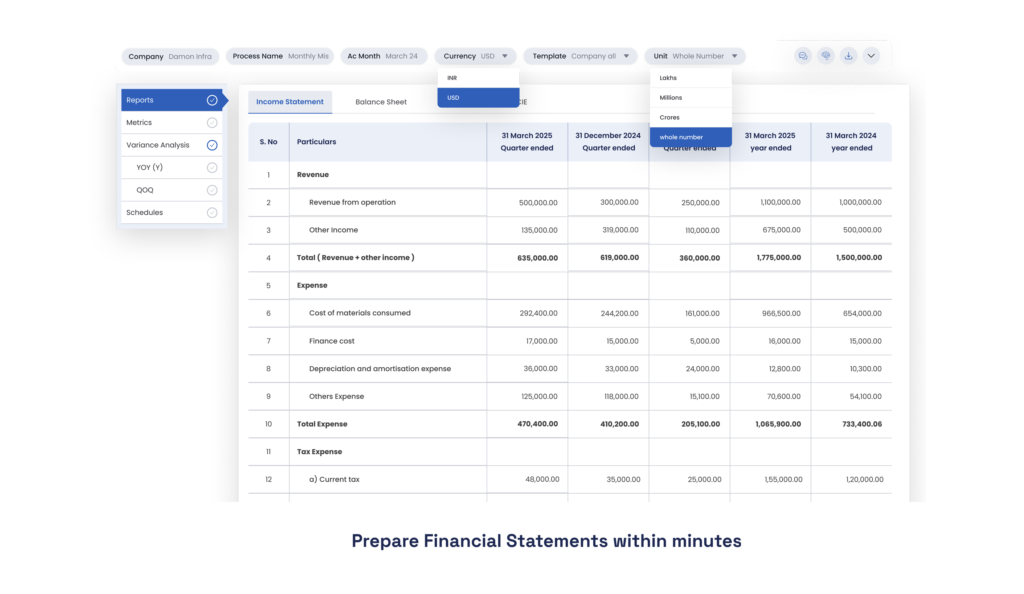

Modern finance teams are under increasing pressure to deliver faster reporting, higher accuracy, and deeper financial insights. As organizations grow across regions, currencies, and subsidiaries, manual consolidation processes quickly become inefficient and prone to error. This is why many enterprises are adopting Financial Consolidation Software to streamline their financial operations. Advanced platforms like Result Lane leverage automation, artificial intelligence, and integrated analytics to transform how companies consolidate financial data. By eliminating manual tasks and introducing intelligent workflows, automated consolidation solutions are helping finance leaders move from reactive reporting to strategic financial management.
The Traditional Financial Consolidation Challenge
Financial consolidation is the process of combining financial data from multiple subsidiaries, departments, or business units into a single unified set of financial statements. These statements provide a comprehensive view of an organization’s financial position and performance.
Historically, finance teams relied heavily on spreadsheets and manual processes to complete consolidation tasks. While spreadsheets offered flexibility, they introduced several operational challenges:
- Time-consuming data collection from multiple systems
- High risk of formula errors and version conflicts
- Difficult intercompany transaction reconciliation
- Delayed financial close cycles
- Limited visibility into real-time financial performance
As businesses expanded globally, these challenges became even more complex. Consolidating financial information across multiple currencies, accounting standards, and reporting structures required significant manual effort.
Automation has fundamentally changed this landscape.
The Role of Automation in Financial Consolidation
Automation in financial consolidation refers to the use of software-driven workflows, data integration tools, and intelligent algorithms to streamline consolidation processes.
Instead of manually gathering and reconciling financial data, automated consolidation platforms perform many tasks automatically, including:
- Data extraction from ERP and accounting systems
- Currency conversions and adjustments
- Intercompany transaction elimination
- Validation and compliance checks
- Consolidated financial reporting
This shift allows finance teams to focus less on repetitive tasks and more on financial analysis and strategic planning.
Key Ways Automation Is Transforming Financial Consolidation
Automation is reshaping the financial consolidation process in several significant ways.
1. Automated Data Collection and Integration
One of the most time-consuming aspects of financial consolidation is gathering financial data from multiple sources.
Automation enables consolidation software to integrate directly with ERP systems, accounting platforms, and financial databases. This allows the system to automatically collect financial data from various business units without manual data entry.
Benefits include:
- Reduced data entry errors
- Faster data aggregation
- Improved consistency across financial reports
By centralizing financial data, organizations can create a single source of truth for financial reporting.
- Faster Financial Close Processes
Closing financial books at the end of each reporting period traditionally requires extensive manual reconciliation and validation.
Automated consolidation software accelerates this process by performing real-time data validation, automated journal entries, and reconciliation workflows.
As a result:
- Financial close cycles are significantly shorter
- Finance teams can generate reports faster
- Leadership gains timely access to financial insights
Many organizations that adopt automated consolidation platforms reduce their close cycle from weeks to just a few days.
- Intelligent Intercompany Eliminations
Intercompany transactions—such as sales between subsidiaries—must be eliminated during consolidation to avoid double counting.
Manually identifying and reconciling these transactions is both complex and time-consuming.
Automation allows consolidation software to automatically detect intercompany transactions, match them across entities, and perform elimination entries during the consolidation process.
This improves both accuracy and efficiency while reducing reconciliation workloads.
- Automated Multi-Currency Conversion
Global organizations must consolidate financial data from subsidiaries operating in different currencies.
Automated financial consolidation systems handle currency conversions using predefined exchange rates and accounting rules.
Key benefits include:
- Accurate currency translation
- Compliance with international accounting standards
- Simplified reporting for global operations
Automation ensures currency conversions are applied consistently across financial reports.
- Real-Time Financial Reporting and Analytics
Traditional consolidation processes often delay financial insights until after the close cycle is complete.
Automated consolidation software enables real-time financial reporting by continuously updating financial data as transactions occur.
Finance leaders can access dashboards and reports that provide instant visibility into:
- Revenue performance
- Cost structures
- Profitability across entities
- Cash flow trends
This real-time visibility supports faster and more informed business decisions.
- Enhanced Compliance and Audit Readiness
Regulatory compliance is a critical requirement for financial reporting. Companies must adhere to accounting frameworks such as IFRS and GAAP.
Automated consolidation platforms provide built-in compliance controls, including:
- Audit trails for every financial adjustment
- Automated validation checks
- Standardized accounting rules across subsidiaries
These capabilities simplify audits and reduce the risk of regulatory issues.
How AI Is Expanding Financial Consolidation Automation
Automation in financial consolidation is increasingly powered by artificial intelligence.
AI-driven features are enabling consolidation software to go beyond basic automation by introducing predictive capabilities and intelligent insights.
Examples include:
Predictive Financial Forecasting
AI algorithms analyze historical financial data to generate forecasts and identify future financial trends.
Anomaly Detection
Machine learning models can detect unusual transactions or inconsistencies in financial data, helping finance teams identify errors or potential fraud.
Intelligent Workflow Automation
AI-powered workflows can automatically trigger approval processes, reconciliations, and reporting tasks based on predefined conditions.
These capabilities transform financial consolidation from a purely reporting function into a strategic financial intelligence platform.
Strategic Advantages for Finance Teams
Automation is not only improving efficiency but also redefining the role of finance teams within organizations.
With automated consolidation systems, finance professionals can shift their focus from manual data processing to high-value activities such as:
- Strategic financial planning
- Performance analysis
- Business forecasting
- Risk management
This evolution allows finance departments to play a more proactive role in guiding organizational strategy.
Result Lane’s Approach to Automated Financial Consolidation
Result Lane represents a new generation of financial technology platforms designed to modernize financial consolidation and performance management.
The platform combines automation, cloud-based architecture, and advanced analytics to simplify complex financial processes.
Key strengths include:
Unified Financial Data Management
Result Lane integrates financial data from multiple systems into a centralized platform, eliminating data silos.
Automated Consolidation Workflows
Automated workflows streamline processes such as intercompany eliminations, currency conversions, and financial adjustments.
Real-Time Financial Visibility
Interactive dashboards provide finance leaders with real-time insights into financial performance across the organization.
Scalable Architecture
The platform is designed to support growing organizations with complex multi-entity structures and global operations.
By combining automation with intelligent analytics, Result Lane enables finance teams to operate more efficiently while gaining deeper financial insights.
The Future of Automated Financial Consolidation
Automation will continue to transform financial consolidation as new technologies emerge.
Key trends shaping the future include:
- Continuous financial close processes
- AI-powered financial planning
- Real-time global financial reporting
- Autonomous finance operations
As organizations increasingly rely on data-driven decision-making, automated financial consolidation platforms will become a core component of modern financial management.
Conclusion
Automation is revolutionizing financial consolidation by eliminating manual processes, improving data accuracy, and accelerating financial reporting cycles. Modern consolidation software enables organizations to integrate financial data across multiple entities, currencies, and systems while maintaining compliance with global accounting standards.
By adopting automated platforms like Result Lane, businesses can transform their financial operations, reduce reporting complexity, and gain real-time insights into their financial performance. As automation and artificial intelligence continue to evolve, financial consolidation software will play an increasingly critical role in enabling organizations to operate with greater agility, transparency, and strategic insight.