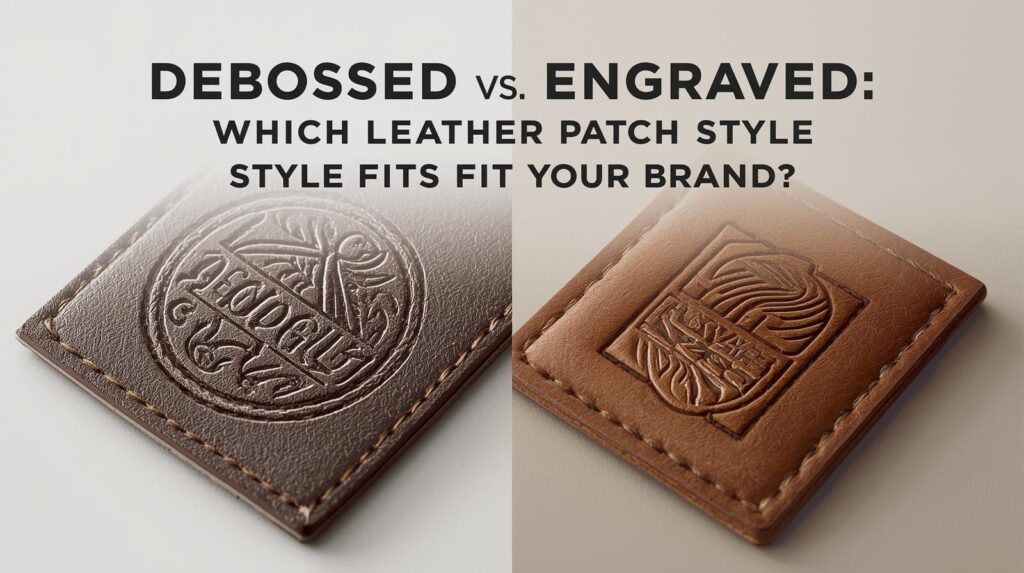

Most branding today is a digital hallucination. It lives on a screen, pixels flickering in a vacuum, gone the moment you look away. But leather? Leather has weight. It has a scent. It has a memory. When you’re deciding between debossing and engraving for your brand’s signature look, you aren’t just picking a manufacturing process. You’re choosing the physical DNA of your company’s handshake.
If you’re hunting for a Leather Patches Maker, you’ve likely realized that a standard printed sticker or a flimsy embroidered patch isn’t going to cut it anymore. We are living in an era of “tactile hunger.” People want to touch their clothes. They want to feel the ridges, the grain, and the resistance of a material that lived before it was worn.
But here’s the rub: if you choose the wrong method, your high-end vision can end up looking like a craft fair accident or, conversely, a sterile piece of plastic. Let’s dismantle the mechanics of the press and the laser to see which one actually earns a place on your gear.
The Brutalist Beauty of Debossing
Let’s start with the heavy hitter. Debossing is essentially a controlled physical assault on a piece of hide. To create custom embossed leather patches (and yes, in the industry, “embossed” is often the catch-all term for these deep-pressed valleys), a Leather Patches Maker has to commission a custom metal die.
This die is a mirror image of your logo, machined out of brass or steel. It’s heated until it’s screaming hot and then driven into the leather with enough hydraulic pressure to crush the fibers into a permanent, recessed shape.
The “Heirloom” Factor
There is a specific, primal gravity to a debossed patch. Because the leather is physically compressed, the area where your logo sits becomes denser, smoother, and often darker due to the heat. This is “Old World” branding. It’s the same logic used by cattle ranchers a century ago, and it’s the reason why luxury heritage brands—the ones that charge $400 for a weekend bag—almost exclusively use this method.
- The Depth: You can feel a debossed logo in total darkness. It creates a 3D landscape on the surface of the garment.
- The Light: Because the logo is recessed, it creates its own shadows. As the wearer moves, the logo appears to shift and deepen.
- The Survival: You can’t scratch off a deboss. You could drag a debossed patch behind a truck through a gravel pit, and while the leather might get beat up, the “valley” of your logo will remain. This is why it’s the gold standard for hat Leather patches makers who cater to the outdoor and workwear markets.
The “High-Friction” Reality
The downside? It’s not for the faint of heart or the hyper-complex. If your logo looks like a messy spiderweb of thin lines, debossing will turn it into a muddy crater. It requires bold, confident shapes. It demands “breathing room” between elements. If you try to cram a 50-word mission statement into a 2-inch debossed circle, you’re going to end up with a blurry mess that looks like a thumbprint.
The Digital Precision of Engraving
On the other side of the ring, we have laser engraving. This isn’t about pressure; it’s about light. A high-intensity CO2 laser dances across the surface of the leather, vaporizing the top layer of cells to leave a blackened, precise mark.
If debossing is a sledgehammer, engraving is a scalpel.
The Anatomy of the Laser
When you work with hat Leather patches makers who specialize in engraving, you gain a level of detail that would be impossible with a metal die. Do you have a logo with tiny, 2-point font? Do you have a realistic illustration of a mountain range with individual pine trees? The laser doesn’t care. It will render every single needle on those trees with terrifying accuracy.
- The Contrast: On lighter leathers—think honey, tan, or “natural” veg-tan—the laser leaves a dark, charred finish. This creates a high-contrast “pop” that is visually arresting.
- The Texture: Unlike the deep valley of a press, engraving is relatively shallow. It feels more like a texture change than a structural one. It’s “etched” rather than “forged.”
- The Speed: Because there’s no custom metal die to machine, engraving is often the fastest way to get a prototype in your hands.
The Tangent: The Smell of Authenticity
Here is a weird “human” glitch in the process: the smell. When a laser hits genuine leather, it smells like a campfire. It’s the scent of organic material being scorched. If you’re using “vegan” leather or synthetic hides, the laser will smell like a chemical spill. It’s an accidental litmus test for quality. If your Leather Patches Maker isn’t using the real stuff, the laser will tell on them immediately.
The Brand Psychology: Who Are You?
Choosing between these two isn’t a technical decision; it’s a psychological one. You have to ask yourself: “What does my brand smell like?”
The “Workhorse” Brand
If your brand is built on the idea of durability—if you’re selling to carpenters, hikers, or people who actually use their hands—you need the deboss. You want that rugged, deep-pressed look. It signals that your product can take a beating. It suggests that, like the leather itself, your brand will only get better with age.
The “Artisanal” Brand
If you’re a boutique coffee roaster or a high-end barber shop, the laser-engraved patch offers a “designer” feel. It’s clean. It’s intentional. It looks like it was designed on a MacBook Pro, not carved with a hunting knife. It fits the “modern-vintage” aesthetic that defines urban style today.
The “Affordability” Trap
Let’s talk money, because everyone pretends they don’t care until the invoice hits the inbox.
Finding Affordable hat Leather patches makers usually leads people toward engraving for small runs. Why? Because the setup cost is lower. You don’t have to pay $100+ for a custom brass die. You just upload a vector file and hit “print.”
However—and this is a big “however”—if you are scaling, debossing becomes the smarter financial play. Once that metal die is made, it can stamp thousands of patches with zero degradation. It’s a one-time investment in a tool that will outlast your current marketing strategy. At Leather Patches, we often see brands start with engraving for their “Beta” launch and then graduate to the deep-press deboss once they’ve proven their concept. It’s a natural evolution of quality.
The Hidden Third Option: The Hybrid
Some of the most “talismanic” patches I’ve ever seen use both. Imagine a deep-pressed (debossed) border that gives the patch a physical frame, with a laser-engraved serial number or fine-lined detail in the center.
This is how you beat the “beige” of the internet. You combine the ancient (the press) with the futuristic (the laser). You create something that feels like it was unearthed from a time capsule but also looks like it belongs in a high-end gallery.
A Warning on Consistency
Whether you choose the press or the beam, consistency is the ghost that haunts every Leather Patches Maker. Leather is a biological product. One cow lived a different life than the next. One hide might be oilier, another drier.
A deboss will hit a dry piece of leather differently than a supple, oily piece. A laser will char a “Sun-tanned” hide darker than a “Mahogany” hide. This isn’t a flaw—it’s the point. If you wanted every single piece to be identical, you’d be using plastic. Embrace the “human” variance. It’s what tells your customer that they aren’t holding a mass-produced piece of junk.
The Final Cut
We are drowning in a world of the “disposable.” Everything is made of glues, resins, and thin veneers. A leather patch—whether it’s the deep, shadowy valley of a deboss or the sharp, scorched precision of an engraving—is a rebellion against that disposability.
It’s a signal. It says: “We gave a damn about the details.”
When you’re ready to stop blending into the background of the “ever-evolving” (sorry, I almost used a forbidden word there) fashion landscape, you need to pick a side. Do you want the heavy, physical presence of the press, or the sharp, digital clarity of the laser?
There is no “wrong” answer, only a “wrong” fit for your brand’s soul.
At Leather Patches, we don’t just “leverage” (another bad word, forgive me) technology to make stickers. We treat the hide with the respect it earned by existing. We help you find the rhythm in the grain.
Stop settling for the flat. Stop settling for the printed. Go find a Leather Patches Maker who understands the friction of the craft, get your custom embossed leather patches in motion, and give your customers something they can actually feel.
The internet is full of noise. Leather is a silence that speaks volumes. Which one are you going to be?