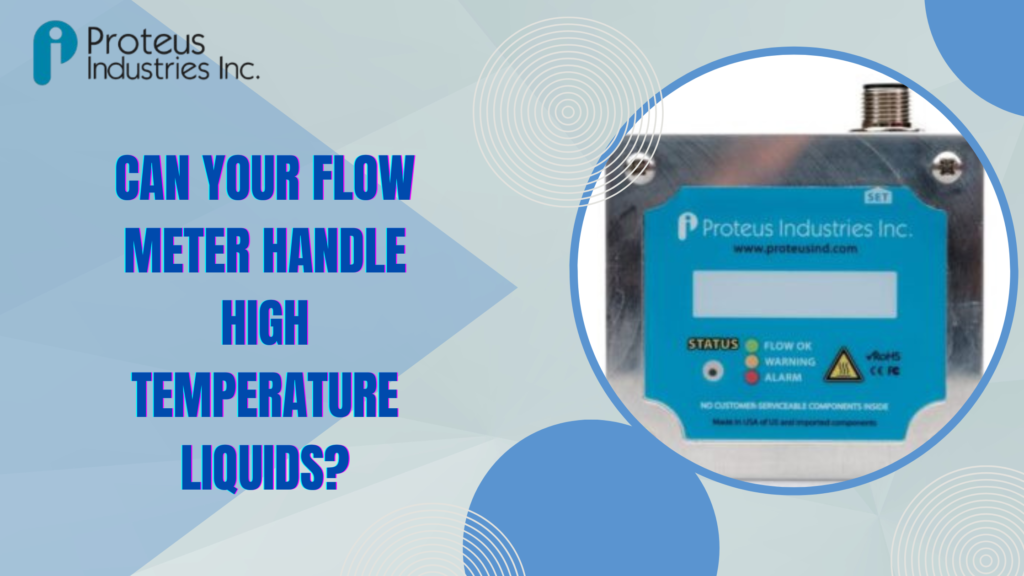

Most industrial operators focus on flow meter accuracy, pipe size, and whether the meter works with the fluid being measured. These factors are important. However, there is another variable that often gets overlooked, and it can cause more damage, downtime, and operational problems than almost anything else.
Temperature.
Specifically, can your flow meter handle the temperature of the liquid moving through your system?
If you operate anywhere in the United States and your process uses liquids at high temperatures, such as in power plants, refineries, chemical plants, food processing lines, or HVAC systems, this question is not just important. It is critical.
Because if the answer is no, you already have a problem. You just might not k now it yet.
Why Temperature Is the Variable Most People Underestimate
Many operators are surprised to learn that most flow meters are not made for high temperature liquids.
They are designed for standard operating conditions. Normal temperatures. Typical pressures. Everyday fluids.
When those conditions change and the high temperature liquid flow meter rises well above the standard range, problems begin to develop inside the meter. These issues do not happen suddenly, but build up over time until the meter stops working properly.
The problem is that this wear is often hidden until it becomes serious. The meter keeps working and giving readings, but those readings slowly become less accurate. Often, no one notices until a process fails, a compliance check is missed, or the equipment breaks down.
Understanding exactly why this happens is the first step toward making sure it never happens to you.
What High Temperatures Do to Standard Flow Meters
Seals and Gaskets Break Down
The seals and gaskets inside a standard flow meter are typically made from materials that perform well within a defined temperature range. Push them beyond that range and they begin to soften, deform, and lose their ability to maintain a proper seal.
In a high temperature lIn high temperature liquid applications, this damage happens all the time. Each day the meter faces heat above its limit, the seals get a bit weaker. When they finally fail, the results can range from expensive leaks to real safety risks. Malfunction
Modern flow meters use advanced electronics like sensors, transmitters, and circuit boards to turn physical flow into accurate digital readings. These parts have temperature limits. If those limits are exceeded, the electronics can start to act unpredictably.
Sensors can drift, giving readings that seem correct but are actually wrong. Circuit boards may develop problems that hurt performance. Transmitters might send mixed signals. In the worst cases, the electronics can fail completely, leaving you with no measurement in a system where measurement is essential.
Materials Expand Unevenly
Everything expands when heated — but differenEverything expands when heated, but different materials expand at different rates. In a standard flow meter exposed to high temperature liquid flow meter, this uneven expansion causes mechanical stress throughout the device.me misaligned. Parts that moved freely begin to bind. Connections that were tight become loose. Over time this accumulated stress degrades accuracy, increases wear, and eventually causes physical failure.
Moving Parts Wear Out Fast
For flow meters with moving parts, such as turbine meters commonly used in industry, high temperature liquids present a serious challenge.
The precision tolerances that allow moving parts to function correctly get thrown off by thermal expansion. Lubricants break down under heat. Materials that were selected for their properties at normal temperatures behave very differently when hot liquids are flowing through them constantly.
The result is accelerated wear, reduced accuracy, and mechanical failure that arrives far sooner than it should.
Industries Across the US That Face This Challenge Every Day
High temperature liquid flow measurement is not a niche concern. It is a daily operational reality across a wide range of American industries.
Power Generation — Power plants across the United States Power Generation: Power plants across the United States depend on accurate measurement of superheated water and steam systems. If flow measurement is inaccurate, it affects not only efficiency but also safety and regulatory compliance.ss liquids at temperatures that would destroy standard flow meters in weeks. Specialized high temperature measurement equipment is not optional in these environments — it is essential.
Chemical Processing — The US chemical industry operates some of the most temperature-intensive processes in any sector. Accurate flow measurement of hot reactants, solvents, and products is fundamental to safety, quality, and process efficiency.
Food and Beverage Manufacturing — From pasteurization to sterilization, American food and beverage producers handle hot liquids that require reliable, accurate flow measurement to meet FDA standards and maintain product quality.
HVAC Systems — Large commercial and industrial HVAC systems across the country depend on accurate high temperature flow measurement to optimize energy efficiency and maintain system performance.
Pharmaceutical Manufacturing — US pharmaceutical facilities operate under some of the strictest regulatory requirements in the world. High temperature sterilization processes demand flow measurement equipment that performs with absolute reliability.
What the Right High Temperature Flow Meter Looks Like
So what separates a flow meter that can handle high temperature liquids from one that cannot?
It comes down to three key factors: materials, technology, and design.
Materials: High temperature flow meters use materials chosen for their ability to perform well under heat. They have special seal compounds that stay strong at high temperatures, housing materials that handle thermal expansion without losing shape, and electrode and sensor materials that work reliably even with constant heat.
Technology — Certain flow measurement technologies are inherently better suited toTechnology: Some flow measurement technologies are naturally better for high temperature applications than others.e most reliable choices for high temperature liquid measurement. Electromagnetic meters with high temperature liners and electrode configurations handle hot conductive liquids excellently. Ultrasonic meters with specially rated transducers can even be configured for non-invasive measurement — keeping all the sensitive components outside the hot liquid entirelDesign: High temperature flow meters are built specifically for the tough conditions they face. They include thermal isolation between the hot process connection and sensitive electronics, extended necks to keep transmitters away from heat, and temperature-compensated calibration to keep accuracy across the full range.nge.
How to Know If Your Current Meter Is Struggling
There are warning signs that your current flow meter may not be handling your high temperature liquid application as well as it should.
Readings that seem inconsistent or slightly off without any obvious cause. Unexplained differences between your flow measurement and your process outcomes. Seals or gaskets that need replacing more frequently than expected. Electronic components that are showing signs of heat stress. Accuracy that seems to have drifted from what it was when the meter was first installed.
Get the Right Solution With Proteus Industries
At Proteus Industries, we have helped American industrial operations solve high temperature flow measurement challenges for decades, and we understand what is at stake.
We know that in your operation accurate flow measurement is not just about data. It is about safety, efficiency, compliance, and keeping your process running at its best every single day.
Our range oOur range of high temperature flow meters is built for the tough conditions found in US industrial facilities. They use the right materials, technology, and design to provide accurate, reliable measurement even when liquids are hot and the stakes are high.r current flow meter really up to the job? Contact Proteus Industries today — and let our experts help you find a solution that handles your high temperature liquids with confidence, accuracy, and reliability.
Because in high temperature applications getting the measurement right is not optional. It is everything.