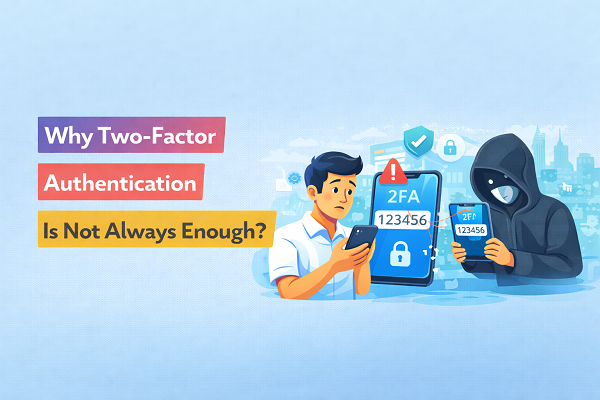

For years, two-factor authentication (2FA) was presented as the ultimate safeguard against account compromise. Security experts encouraged users to add an extra verification step — a code sent to a phone, an authenticator app, or a hardware key — to reduce the risk of unauthorized access. Adoption increased steadily, and organizations widely promoted 2FA as a baseline security measure.
Yet despite widespread implementation, data breaches and account takeovers continue. Attackers have adapted, discovering ways to bypass or manipulate authentication processes that once seemed nearly impenetrable.
The reality is not that two-factor authentication has failed. Rather, the threat landscape has evolved faster than many expected.
The Original Promise of Two-Factor Authentication
Two-factor authentication introduced a simple but powerful concept: verifying identity through two independent factors instead of relying solely on passwords.
These factors typically include:
- Something you know (password or PIN)
- Something you have (phone or hardware token)
- Something you are (biometric data)
Adding an extra layer dramatically reduced the success rate of traditional password-based attacks such as credential stuffing or brute-force attempts.
Microsoft has reported that multi-factor authentication blocks the vast majority of automated account compromise attempts. This effectiveness explains why organizations quickly adopted it as a standard security practice.
However, attackers began shifting strategies rather than abandoning their efforts.
Social Engineering Has Become More Sophisticated
Many successful breaches involving 2FA rely on human manipulation rather than technical weaknesses.
Phishing campaigns now mimic legitimate login pages with remarkable accuracy. Attackers trick users into entering credentials and verification codes on fake websites, capturing authentication data in real time.
Some attacks involve phone calls impersonating support staff, convincing users to share verification codes directly.
Because 2FA often relies on user action, social engineering exploits trust rather than technology.
As phishing techniques improve, users face increasing difficulty distinguishing legitimate prompts from malicious ones.
SIM Swapping and SMS Vulnerabilities
SMS-based authentication remains widely used due to convenience, yet it introduces unique risks.
SIM swapping attacks allow criminals to transfer a victim’s phone number to a new device by exploiting weaknesses in telecom support processes. Once attackers control the number, they receive verification codes intended for the legitimate user.
High-profile cryptocurrency thefts and account takeovers have demonstrated the effectiveness of this method.
Security experts increasingly recommend moving away from SMS-based authentication toward authenticator apps or hardware tokens when possible.
Convenience often conflicts with security.
Read: Why Tampa Needs a UV Safety & Skincare App Right Now?
Real-Time Man-in-the-Middle Attacks
Another emerging threat involves real-time interception.
Attackers deploy proxy servers that sit between users and legitimate websites. When victims log in, the attacker captures both the password and the one-time code simultaneously, allowing immediate access.
These attacks exploit timing rather than encryption weaknesses. Even secure one-time passwords can become ineffective if attackers intercept them instantly.
As authentication methods improve, adversaries focus on bypassing them during execution rather than breaking them outright.
Push Notification Fatigue
Many platforms use push-based authentication where users approve login attempts via mobile notifications.
While convenient, this approach introduces a new risk: notification fatigue.
Attackers may trigger repeated login prompts, hoping users approve one out of frustration or confusion. This technique, sometimes called “push bombing,” relies on psychological pressure rather than technical vulnerability.
Organizations must balance usability against resilience to manipulation.
The Role of Session Hijacking
Authentication verifies identity at login, but security risks continue afterward.
Session hijacking attacks allow criminals to steal active session tokens, bypassing the need for authentication entirely. Malware, browser vulnerabilities, or insecure networks can expose session data.
Once attackers gain access to a session, they may operate within an account without triggering additional verification.
This highlights an important limitation: authentication protects entry points but does not guarantee ongoing safety.
Third-Party Integrations Expand Risk
Modern digital ecosystems rely heavily on integrations.
Applications connect through APIs, plugins, and external services to share data and functionality. Even if a primary account uses strong authentication, vulnerabilities in connected services can create indirect access paths.
For example, teams involved in mobile app development Austin environments often integrate analytics platforms, payment gateways, and cloud services. Each integration expands potential exposure if security practices differ across vendors.
Two-factor authentication protects individual accounts, but interconnected systems introduce additional complexity.
Malware and Device Compromise
If a device itself becomes compromised, authentication layers may lose effectiveness.
Malware can capture keystrokes, intercept messages, or manipulate browser sessions. Attackers may wait until users authenticate successfully and then hijack active access.
Endpoint security becomes as important as account security.
Protecting identity verification alone cannot compensate for compromised devices.
Overreliance on Single Security Measures
One of the biggest misconceptions about cybersecurity is the belief in single solutions.
Organizations sometimes treat 2FA as a complete defense rather than one component within a broader strategy. When security programs rely too heavily on one mechanism, attackers focus on bypassing it.
Effective security typically involves multiple layers:
- Strong password policies
- Device monitoring
- Behavioral analytics
- Network segmentation
- Continuous authentication checks
Two-factor authentication remains valuable, but it works best within a layered approach.
Usability Versus Security Trade-Offs
Security measures must remain usable to achieve adoption.
Complex authentication systems may frustrate users, leading to shortcuts or resistance. Organizations often compromise between strict protection and seamless experience.
This tension shapes how authentication evolves.
Biometric systems, passkeys, and passwordless authentication aim to improve both convenience and security simultaneously. Whether these approaches fully replace traditional 2FA remains uncertain.
The Future of Identity Verification
As threats evolve, authentication methods continue changing.
Passwordless authentication using cryptographic keys gains momentum. Behavioral biometrics analyze typing patterns or interaction habits to detect anomalies. Continuous authentication models monitor activity throughout a session rather than verifying identity only at login.
The shift reflects a deeper understanding: identity verification is not a single event but an ongoing process.
Security becomes dynamic rather than static.
Closing Reflection
Two-factor authentication marked a major step forward in digital security. It reduced reliance on weak passwords and blocked many automated attacks.
Yet security is never permanent.
Attackers adapt quickly, targeting human behavior, device vulnerabilities, and system complexity. Two-factor authentication remains essential, but it is not sufficient on its own.
The future of cybersecurity lies in layered defenses, continuous monitoring, and a realistic understanding that no single tool guarantees safety.
In an interconnected digital world, resilience depends not on one barrier, but on a system designed to withstand constant change.
Read: Why Evaluation Frameworks Are Replacing Traditional Testing in AI