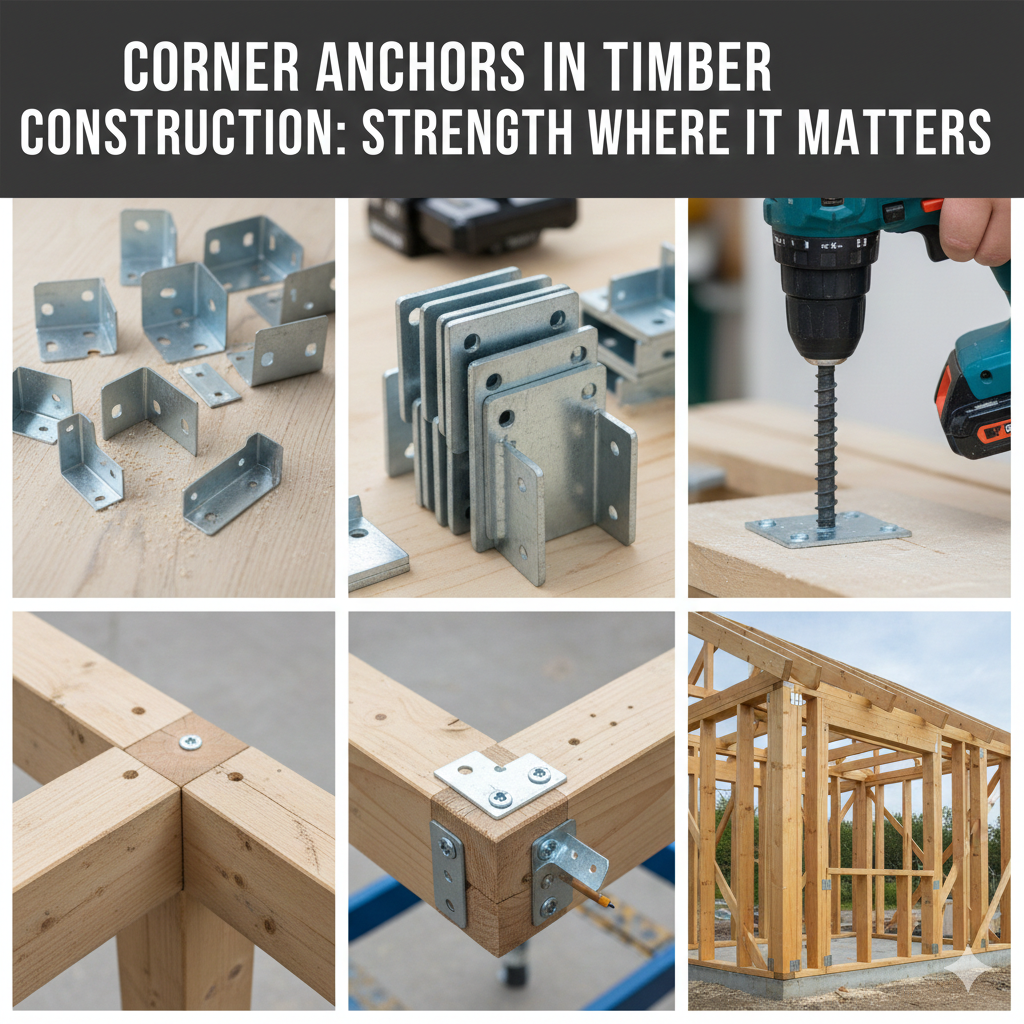

Timber construction has experienced a strong resurgence in modern building. From residential framing and garden structures to commercial timber frameworks, wood remains one of the most versatile and sustainable building materials available.
However, timber’s strength depends not only on the quality of the wood itself — but on how securely its joints are connected.
One of the most critical connection points in any timber structure is the corner joint. This is where loads transfer, forces concentrate, and stability is tested. Proper reinforcement at these intersections is essential, and this is where Corner anchors play a vital role.
In this article, we explore why corner anchors are fundamental in timber construction, how they work, and how to choose the right type for structural integrity and long-term durability.
Why Corner Strength Is Critical in Timber Structures
In timber construction, corners are structural stress points.
They must resist:
- Vertical loads (weight from above)
- Lateral forces (wind pressure)
- Torsion (twisting forces)
- Dynamic loads (movement or vibration)
Without proper reinforcement, wooden joints may shift, separate, or weaken over time.
Corner anchors provide mechanical reinforcement that stabilizes joints and distributes forces evenly across the structure.
What Are Corner Anchors?
Corner anchors are metal brackets designed to connect two wooden elements at a 90-degree angle. They are typically made from galvanized or stainless steel and feature pre-drilled holes for screws or bolts.
Their purpose is simple yet essential:
- Strengthen right-angle joints
- Prevent movement under load
- Improve structural rigidity
High-quality Corner anchors are engineered to provide reliable load transfer while maintaining structural alignment.
Applications in Timber Construction
Corner anchors are widely used across various timber applications.
1. Structural Framing
In timber frame buildings, corner anchors reinforce wall intersections and support beams. They help ensure that vertical and horizontal components remain securely connected.
2. Roof Structures
Roof trusses and support beams often rely on reinforced corner joints to withstand wind uplift and weight loads.
3. Decking and Outdoor Structures
Garden pergolas, terraces, and fencing systems require stable corner joints to resist environmental stress.
4. Interior Timber Projects
Shelving systems, cabinetry frameworks, and wooden partitions benefit from reinforced right-angle joints for long-term stability.
In all these scenarios, durable Corner anchors enhance structural integrity and prevent gradual loosening.
Load Distribution and Structural Safety
The main advantage of corner anchors lies in their ability to distribute loads efficiently.
Instead of relying solely on wood-to-wood fastening (such as screws driven at angles), corner anchors:
- Provide multiple fastening points
- Spread stress across a larger surface area
- Reduce the risk of wood splitting
- Enhance resistance to lateral movement
This mechanical reinforcement is particularly important in load-bearing constructions.
Types of Corner Anchors
Not all corner anchors are identical. Selection depends on structural requirements.
Standard Angle Brackets
Used for light to medium-duty applications such as furniture or non-load-bearing frames.
Reinforced Structural Corner Anchors
Designed for heavy-duty timber framing. They feature thicker steel and additional screw holes for increased load capacity.
Adjustable Corner Anchors
Allow slight flexibility during installation, useful in renovation projects.
Stainless Steel Anchors
Recommended for outdoor or humid environments where corrosion resistance is essential.
Selecting the appropriate Corner anchors ensures long-term durability and compliance with structural demands.
Choosing the Right Corner Anchor
When selecting corner anchors, consider the following factors:
1. Load Requirements
Determine whether the joint is load-bearing or primarily stabilizing.
Heavier loads require:
- Thicker steel
- More fastening points
- Certified load ratings
2. Timber Dimensions
The anchor size should match the dimensions of the wooden beams or posts.
Oversized anchors may interfere with finishing, while undersized anchors may compromise strength.
3. Environmental Exposure
For exterior projects:
- Use galvanized or stainless steel anchors
- Ensure corrosion protection
4. Fastening Method
Select compatible screws or bolts with appropriate diameter and length.
Proper screw selection is just as important as anchor quality.
Reliable Corner anchors are manufactured with precise hole placement to optimize load distribution.
Installation Best Practices
Correct installation maximizes performance.
Follow these guidelines:
- Position the anchor precisely at the joint intersection.
- Use structural-grade screws or bolts.
- Tighten evenly without over-torquing.
- Ensure full contact between anchor and wood surface.
- Avoid placing anchors too close to wood edges to prevent splitting.
Proper alignment ensures optimal load transfer and structural stability.
The Role of Corner Anchors in Modern Timber Engineering
Modern timber construction increasingly emphasizes engineered wood products such as laminated beams and cross-laminated timber (CLT). These systems demand reliable fastening methods to maintain structural precision.
Corner anchors provide:
- Consistent mechanical performance
- Simplified assembly
- Reliable joint reinforcement
High-performance Corner anchors are frequently integrated into modular timber construction for enhanced structural safety.
Common Mistakes to Avoid
Even in professional settings, mistakes can compromise joint strength.
Avoid:
❌ Using undersized anchors for load-bearing joints
❌ Ignoring corrosion protection in outdoor settings
❌ Mixing incompatible screw types
❌ Installing anchors unevenly
❌ Over-tightening screws and damaging wood fibers
Attention to detail ensures optimal structural performance.
Why Quality Matters in Structural Fastening
Low-quality metal brackets may:
- Bend under load
- Corrode prematurely
- Have inconsistent hole spacing
- Provide reduced load capacity
In structural timber construction, fastening components must meet high standards.
Premium Corner anchors are manufactured from durable steel and designed for consistent load-bearing reliability.
Investing in certified hardware ensures safety and long-term durability.
Timber Movement and Long-Term Stability
Wood naturally expands and contracts with humidity changes. Properly installed corner anchors accommodate minor movement while maintaining joint integrity.
This flexibility helps prevent:
- Cracking
- Joint separation
- Structural misalignment
Well-designed corner anchors enhance both immediate strength and long-term resilience.
Sustainability and Structural Efficiency
Timber construction is often chosen for sustainability benefits. However, environmental responsibility must not compromise structural safety.
Using durable and corrosion-resistant Corner anchors ensures:
- Extended lifespan
- Reduced need for maintenance
- Long-term structural reliability
Durable fastening systems contribute to the overall sustainability of timber buildings.
Final Thoughts
In timber construction, strength is determined not only by the quality of the wood but by the reliability of its connections. Corner joints are among the most critical structural points, requiring precise reinforcement to withstand vertical, lateral, and dynamic forces.
Corner anchors provide:
- Mechanical stability
- Load distribution
- Resistance to movement
- Long-term structural integrity
Whether used in residential framing, decking systems, roof structures, or interior timber projects, high-quality Corner anchors deliver strength exactly where it matters most.
Careful selection, correct installation, and durable materials ensure safe, stable, and long-lasting timber constructions.