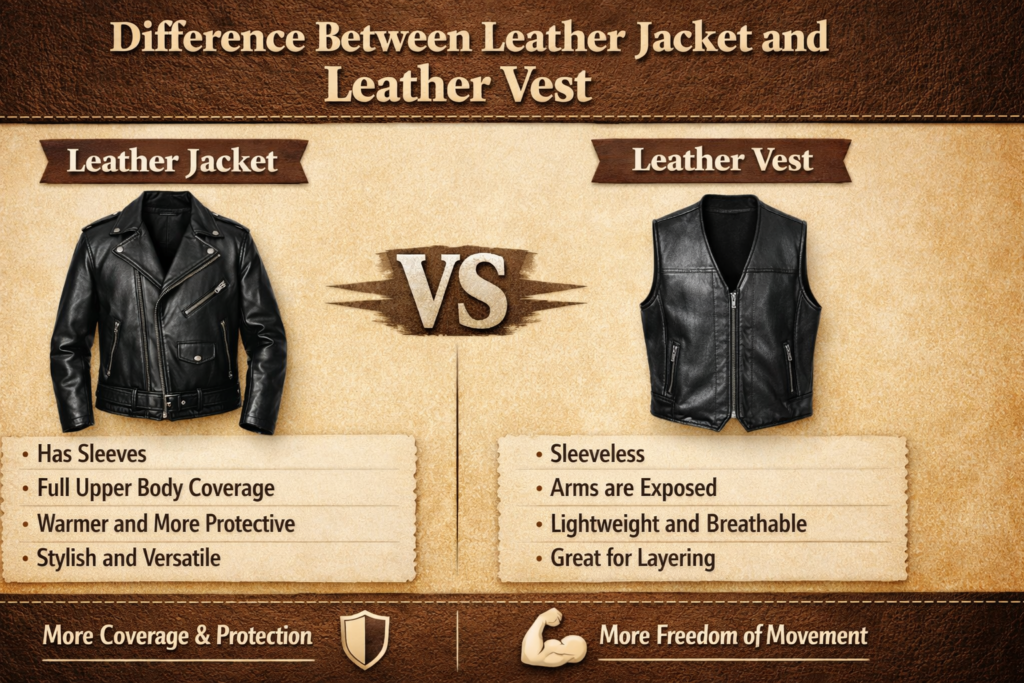

Motorcycle riding apparel is engineered to balance protection, ergonomics, and environmental adaptability. Among the most commonly compared garments are leather jackets and leather vests, both widely used across riding disciplines yet designed for fundamentally different purposes. Leather has long been valued for its abrasion resistance, tensile strength, and durability (Wikipedia, Leather), making it a standard material in protective motorcycle clothing.
Understanding the difference between these two garments requires evaluating structural design, protective capability, riding application, and environmental performance. This analysis provides a professional, fact-driven comparison of the Leather motorcycle jacket and Leather Motorcycle Vests, clarifying how each functions within real-world riding systems and when each should be selected.
Structural Design Differences
Leather Jacket Construction
A Leather motorcycle jacket is a full-coverage outer garment designed to protect the upper body, including shoulders and arms. High-quality jackets typically incorporate reinforced stitching, abrasion-resistant panels, impact-absorbing armor pockets, and wind-blocking closures. The structural objective is to distribute impact force and minimize friction injuries during slides.
Engineering elements often include articulated sleeves, expansion panels, and reinforced seams positioned in high-stress areas. These features improve both safety and mobility, particularly at highway speeds.
Leather Vest Construction
Leather Motorcycle Vests are sleeveless garments designed primarily for airflow, layering, and utility. Their construction focuses on torso durability while maintaining lightweight comfort. Most vests feature adjustable side laces or straps, interior carry pockets, and breathable lining systems.
Because vests lack sleeves and shoulder coverage, they are not engineered as primary protective garments. Instead, they function as supplemental gear layered over protective shirts or under outerwear.
Protection Level Comparison
Protective capability represents the most significant distinction between the two garments.
Coverage Area
Leather jackets protect shoulders, elbows, forearms, chest, and back. Vests protect only the torso.
Impact Resistance
Jackets frequently include removable armor inserts made from viscoelastic polymers or molded composites. Vests typically do not incorporate such components.
Abrasion Performance
Leather’s natural fiber structure resists tearing under friction. However, protection depends on coverage. Jackets offer full upper-body abrasion resistance, whereas vests provide localized protection.
Professional riding safety guidelines emphasize maximizing coverage during high-speed riding, which is why jackets are standard equipment for sport and touring riders.
Environmental Performance and Climate Adaptability
Motorcycle garments must perform across varied weather conditions.
Cold Conditions
Leather jackets provide thermal insulation and wind resistance. Liners, storm flaps, and collar closures further enhance cold-weather performance.
Hot Conditions
Vests excel in warm climates because they allow airflow across the arms and underlayers, reducing heat buildup.
Rain Exposure
While leather is naturally water-resistant, extended rain exposure requires treated finishes or waterproof overlays. Jackets provide more environmental shielding than vests due to greater coverage.
Ergonomics and Rider Mobility
Ergonomics directly affects fatigue and control during rides.
Jackets stabilize the upper body against wind drag, which reduces muscle strain at highway speeds. Their structured sleeves maintain consistent fit even when arms are extended toward handlebars.
Vests allow unrestricted shoulder movement, making them preferable for low-speed cruising or extended urban riding. Reduced garment weight also contributes to comfort during long rides in warm weather.
Functional Use Cases in Real Riding Environments
Professional riding practices demonstrate situational selection rather than universal preference.
High-Speed Riding
Jackets are favored because they provide comprehensive protection and wind resistance.
Cruiser Riding
Vests are commonly used for comfort and ventilation, especially when layered over armored shirts.
Event and Club Riding
Vests are often selected because they display patches and insignia without sleeve obstruction.
Daily Commuting
Jackets are more practical due to unpredictable weather and traffic conditions requiring higher safety margins.
Material Science and Leather Types
Leather performance depends on processing method and hide quality.
- Full-grain leather: Highest durability and abrasion resistance
- Top-grain leather: Slightly lighter with refined texture
- Split leather: Lower durability but improved flexibility
Motorcycle jackets typically use heavier hides for protection, while vests often use mid-weight leather for comfort and mobility.
Expert Insights and Professional Selection Criteria
Industry professionals evaluate riding apparel using performance-based metrics rather than style preferences.
Fit Precision
Protective garments must fit closely to prevent armor displacement and wind drag.
Seam Strength
Double-stitched or triple-stitched seams increase tensile strength and prevent tearing.
Hardware Quality
Corrosion-resistant zippers and reinforced snaps ensure reliability in outdoor conditions.
Weight Distribution
Even weight distribution prevents shoulder fatigue during extended riding sessions.
These criteria are widely accepted standards in motorcycle apparel design because they directly influence safety, comfort, and durability.
Common Misconceptions
Misconception: Vests Provide Equivalent Protection
Vests lack arm and shoulder coverage, which are statistically common impact points in motorcycle accidents.
Misconception: Thicker Leather Always Means Better Gear
Excessive thickness can reduce flexibility and increase fatigue. Optimal thickness balances protection and comfort.
Misconception: Jackets Are Only for Cold Weather
Ventilated leather jackets exist specifically for warm climates and provide protection without overheating.
Misconception: Style Indicates Quality
Visual design does not reflect leather grade, seam strength, or protective capability.
FAQ Section
1. Which is safer for riding, a leather jacket or vest?
Leather jackets are safer because they provide full upper-body coverage and can include protective armor.
2. Are leather vests considered protective gear?
They provide limited abrasion resistance for the torso but are generally classified as supplemental rather than primary protection.
3. Why do some riders prefer vests over jackets?
Vests improve airflow, reduce weight, and allow greater shoulder mobility.
4. Can a vest be worn over protective equipment?
Yes. Many riders layer vests over armored shirts or lightweight jackets.
5. What leather thickness is ideal for motorcycle apparel?
Typically 1.1–1.4 mm for jackets, balancing protection and flexibility. Vests may use slightly lighter leather.
6. Do professional riders wear vests?
They may use them in low-speed or casual riding environments, but jackets are standard for high-speed riding.
7. How should a leather jacket fit properly?
It should fit snugly with sleeves reaching the wrists in riding position and armor aligned with joints.
8. Are leather garments waterproof?
Leather is water-resistant but requires treatment for prolonged rain exposure.
9. Which lasts longer, a jacket or vest?
Longevity depends on leather quality and maintenance, not garment type.
10. Is layering recommended when using a vest?
Yes. Layering improves protection and temperature regulation.
Conclusion
Leather jackets and leather vests are engineered for distinct functional roles within motorcycle apparel systems. Jackets serve as primary protective garments designed to provide impact resistance, abrasion coverage, and environmental shielding. Vests function as lightweight, utility-focused garments optimized for airflow, mobility, and layering flexibility.
The Leather motorcycle jacket is most suitable for riders prioritizing protection, high-speed stability, and all-weather capability. Leather Motorcycle Vests are best suited for comfort-focused riding, warm climates, and layered gear systems.
Selecting between the two requires evaluating riding speed, climate conditions, trip duration, and protection requirements. When chosen according to these practical criteria, each garment becomes an effective component of a comprehensive and safety-focused riding wardrobe.