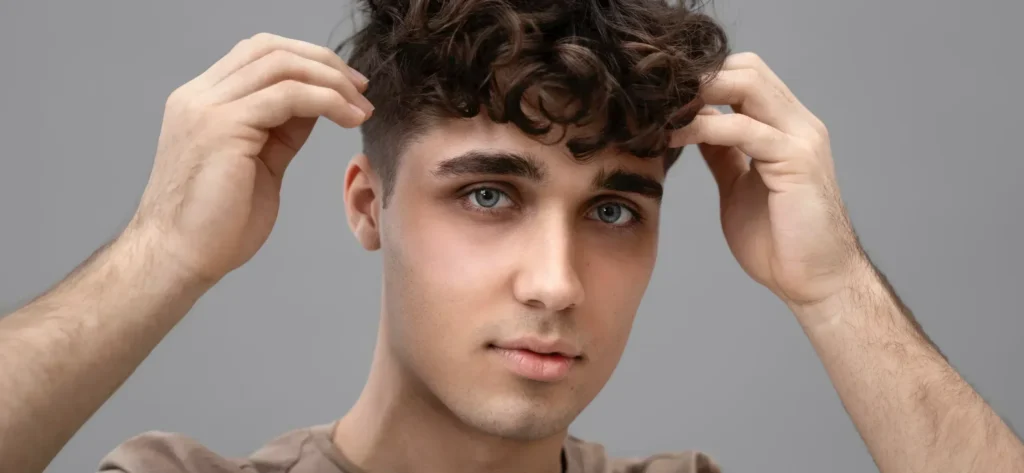

You finally did it. You walked out of the barbershop with a perm , bouncy, textured, full of life. Maybe it’s the wave you’ve been chasing for months, or the curl pattern that finally gives your otherwise flat hair some personality. Either way, you’re feeling good. And then someone tells you: don’t wash your hair for 72 hours.
You nod. You agree. And then you go home and wonder , why? What is actually happening inside your hair during those first three days, and what goes wrong if you ignore that advice?
Let’s break it down properly.
Your Hair Is Not Finished Yet
Here’s what most people don’t realize: when you leave the salon after a Korean Perm Los Angeles, the chemical process is not completely done. Your hair looks curled, yes. But structurally, it’s still in a fragile, transitional state. The bonds inside each strand are still settling into their new configuration , and that process takes time.
To understand why, you need a quick look at what a perm actually does to the hair at a molecular level.
The Chemistry Behind the Curl
Every hair strand is made up of keratin proteins held together by three types of bonds: hydrogen bonds, salt bonds, and disulfide bonds. The disulfide bonds are the most important here. They’re the ones responsible for the shape and structure of your hair.
A perm works in two stages. First, a reducing agent (typically ammonium thioglycolate or a gentler cysteamine in modern perms) breaks those disulfide bonds apart. This softens the hair and makes it pliable; it can now take on whatever shape it’s wrapped around, whether that’s a wave rod, a spiral rod, or a flat iron for a straight perm.
Then the neutraliser is applied. This is the second chemical , usually hydrogen peroxide , and its job is to rebuild those broken disulfide bonds in their new position, locking the curl or wave pattern in place.
The neutraliser does a good job. But it doesn’t complete the job 100% on the day.
What “Structural Stabilisation” Actually Means
After the neutraliser is applied and rinsed out, roughly 20 to 30 percent of the disulfide bonds are still in the process of reforming. They need oxygen, time, and stability to fully cross,link. This is what the 72,hour window is actually about: it’s the period during which those remaining bonds are completing their reconstruction.
Think of it like concrete. The moment it’s poured, it holds its shape. But it doesn’t reach full strength for days. Disturb it too early, and the structure weakens. Hair is the same.
During these 72 hours, the hair shaft is also slightly swollen from the chemicals. The cuticle , the outermost protective layer of the hair , is raised and vulnerable. It hasn’t fully closed back down yet. This is why permed hair in the first three days feels more delicate, more porous, and more sensitive to outside interference than usual.
What Can Go Wrong If You Interfere Too Early
Washing too soon is the most common mistake. Water , especially warm water , swells the hair shaft again, disrupts the hydrogen bonds that are still stabilising, and can pull the newly forming disulfide bonds out of alignment before they’ve set. The result? Loosened curl pattern, frizz, unevenness, and a perm that doesn’t last as long as it should.
Tying your hair up is another one that people underestimate. Any tension on the hair , elastic bands, clips, or tucking behind the ear , can create a crease or distortion in the curl pattern while the bonds are still malleable. Those distortions can become permanent.
Sweating heavily matters more than you’d think. Sweat is slightly acidic and contains salt. Both of these can interact with the hair during this sensitive period. If you’re planning an intense workout, it’s worth holding off for at least 48 hours.
Heat from styling tools is a firm no. The hair is already structurally compromised from the perm chemicals. Applying heat during the stabilisation window stresses the keratin further and can permanently damage the curl formation before it has a chance to fully set.
What You Should Be Doing Instead
Mostly , nothing. And that’s the honest answer. The best thing you can do for your perm in the first 72 hours is leave it completely alone. Sleep on a silk or satin pillowcase if you have one, because cotton creates friction that can rough up the already,raised cuticle. If your hair gets lightly damp from humidity or light rain, pat it dry gently , don’t rub.
If you absolutely must do something, use a tiny amount of a curl,defining product applied with your hands, very gently, without scrunching aggressively. No combs. No brushes. Fingers only, and even then, minimally.
After the 72hour window passes, use a sulphate,free shampoo for the first wash. Sulphates are strong detergents that strip moisture and can interfere with the integrity of a fresh perm. A gentle, hydrating wash will clean without undoing weeks of care.
From that first wash onward, conditioning becomes your priority. Permed hair , by nature of the chemical process , loses some of its natural moisture. Deep conditioning once a week, particularly in the first month, helps the hair fiber stay healthy, elastic, and able to hold its pattern long term.
Conclusion
The 72 hour rule isn’t an arbitrary barbershop superstition. It’s grounded in the actual chemistry of how perms work and how long structural reformation takes at a molecular level. Respecting that window is what separates a perm that lasts four to six months from one that drops out in six weeks.
Good results from a perm aren’t just about the technique in the chair; they’re about what you do the moment you walk out the door. The skill of the person who did it matters enormously, but so does your understanding of what your hair actually needs afterward.If your perm was done at a place like Naamza, where barbers explain the postcare process before you leave the chair, you’re already ahead. That kind of guidance , knowing not just what to do but why , is what makes the difference between a perm that thrives and one that disappoints.
Also, View: Blogs