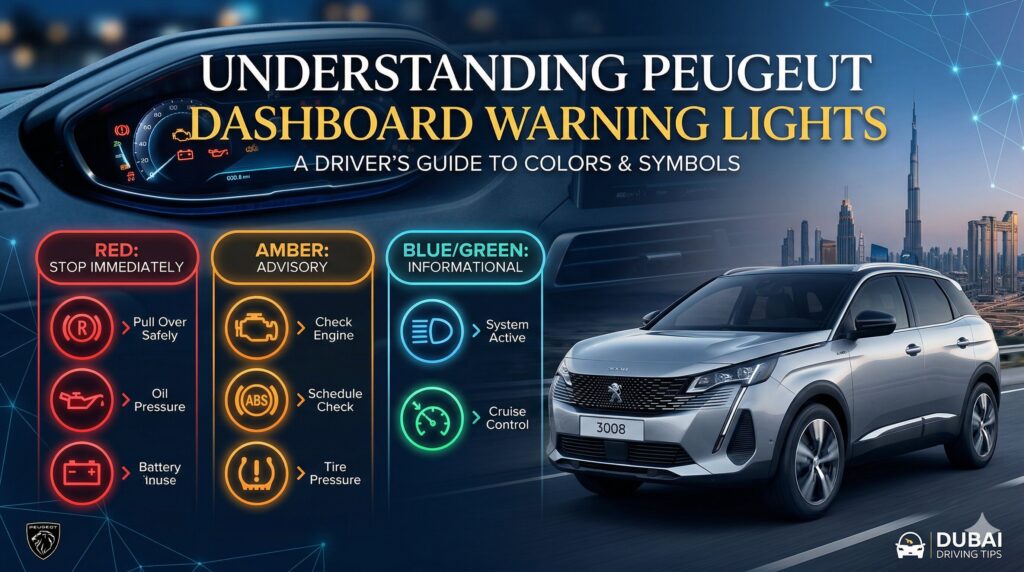

There is a brief moment of panic that every driver feels when an unfamiliar symbol suddenly illuminates on the dashboard. For Peugeot owners, these lights are the vehicle’s way of communicating its internal health. Whether you are driving a sleek 208 through the Marina or taking a 3008 SUV on a family trip to Hatta, understanding these signals is crucial for your safety and the longevity of your car.
In the intense climate of the UAE, sensors can be particularly sensitive to heat and dust. If a light stays on despite a restart, it’s often a sign that your vehicle needs a professional diagnostic check. Finding a specialist for peugeot repair dubai is the most effective way to ensure that a simple sensor glitch doesn’t escalate into a major mechanical failure. In this guide, we will break down the colour-coded system of Peugeot’s dashboard and the specific actions you should take for each.
The Universal Colour Code: Red, Amber, and Blue
Peugeot uses a “Traffic Light” system to categorise the urgency of its dashboard alerts. Ignoring the colour logic is the most common mistake drivers make.
1. Red Warning Lights: Immediate Danger
A red light is a critical alert. It signifies a serious malfunction or a safety risk.
- Action Required: In most cases, you should pull over safely as soon as possible and turn off the engine.
- Common Symbols: Engine Oil Pressure, Battery Charging Fault, and Braking System Fault. Driving with a red light can lead to permanent engine seizure or brake failure.
2. Amber (Yellow/Orange) Warning Lights: Advisory
Amber lights indicate that something is not functioning correctly or a service interval is approaching. The car is usually still drivable, but the issue requires attention soon.
- Action Required: You can typically finish your journey, but you should book a diagnostic appointment within the next few days.
- Common Symbols: Check Engine Light (MIL), Anti-lock Braking System (ABS), and Electronic Stability Program (ESP).
3. Blue or Green Lights: Information
These are not “warning” lights but indicators that a specific feature is active.
- Common Symbols: High beams (Blue), Indicators (Green), or Cruise Control (Green).
Common Peugeot Warning Lights Explained
The “Check Engine” Light (Amber)
This is perhaps the most famous—and frustrating—symbol. In a Peugeot, this light can be triggered by anything from a loose fuel cap to a faulty oxygen sensor or a clogged Diesel Particulate Filter (DPF). If the light is flashing, it indicates an engine misfire that could damage your catalytic converter; in this case, reduce your speed and seek help immediately.
Engine Coolant Temperature (Red)
Given Dubai’s summer temperatures, this is a light you must never ignore. If this illuminates, your engine is overheating.
- What to do: Turn off the AC immediately (it reduces engine load), pull over, and let the engine cool down. Do not attempt to open the radiator cap while the engine is hot.
Service Light (Amber “Wrench”)
If you see a wrench icon, your Peugeot is telling you it’s time for its scheduled maintenance. Because of the dust and heat in the Middle East, Peugeot specialists often recommend following the “Arduous Conditions” service schedule, which involves more frequent oil and filter changes.
Urea / AdBlue Warning (Amber)
Modern Peugeot diesel engines use AdBlue to reduce emissions. If this light comes on, you usually have a countdown (e.g., 1,500 km) before the engine will refuse to start. Refilling the AdBlue tank usually clears the light.
Why Diagnostic Accuracy Matters
Modern Peugeots are equipped with highly sophisticated multiplex wiring systems. Sometimes, a “Brake Fault” light might actually be caused by a low battery voltage rather than the brakes themselves. This is why professional diagnostics are essential. Specialists use Peugeot-specific software (like DiagBox) to read the specific fault codes stored in the car’s computer, ensuring that the repair is targeted and cost-effective.
Frequently Asked Questions (FAQs)
Q1: My Peugeot’s “Check Engine” light came on after I refuelled at a desert station. Could it be the petrol?
Answer (Based on Reddit/r/Peugeot): Yes, it is quite common. If the fuel has a lower octane rating than required or contains impurities, the knock sensor may trigger the light. Try adding high-quality fuel from a reputable station; if the light doesn’t go away after a few drive cycles, you’ll need a technician to clear the fault code and check the filters.
Q2: What does the “Triangle with an Exclamation Mark” mean on my Peugeot 3008?
Answer (Based on Quora): This is a general “Master Warning” light. It usually appears alongside a message on your centre touchscreen or digital cockpit. It could be something as simple as a “Key Battery Low” or “Risk of Ice” (though unlikely in Dubai!), or something more serious. Always check the message display for context.
Q3: Can I reset the service light myself after an oil change?
Answer (Based on Reddit): On most models, you can hold the “000” or “Set” button on the dashboard while turning the ignition to the ‘On’ position (without starting the engine). A countdown will appear. However, resetting it without actually performing the service is risky, as the car’s sensors won’t be able to account for old, degraded oil in the Dubai heat.
Q4: My ABS and ESP lights both came on at the same time. Are my brakes gone?
Answer (Based on Quora): Not necessarily. These systems share the same wheel speed sensors. Often, sand or road debris can coat a sensor, causing it to lose its signal. While your standard brakes will still work, your emergency anti-skid features will not. It’s best to have the sensors cleaned or replaced by a professional.
Conclusion
Your Peugeot’s dashboard is a sophisticated early-warning system designed to save you from expensive repairs. By learning to distinguish between a “stop immediately” red light and a “check soon” amber light, you can drive with confidence. In a city as demanding as Dubai, staying proactive with your vehicle’s alerts is the best way to ensure your Peugeot remains a reliable companion on the road.
Thanks, bloggingarena.com