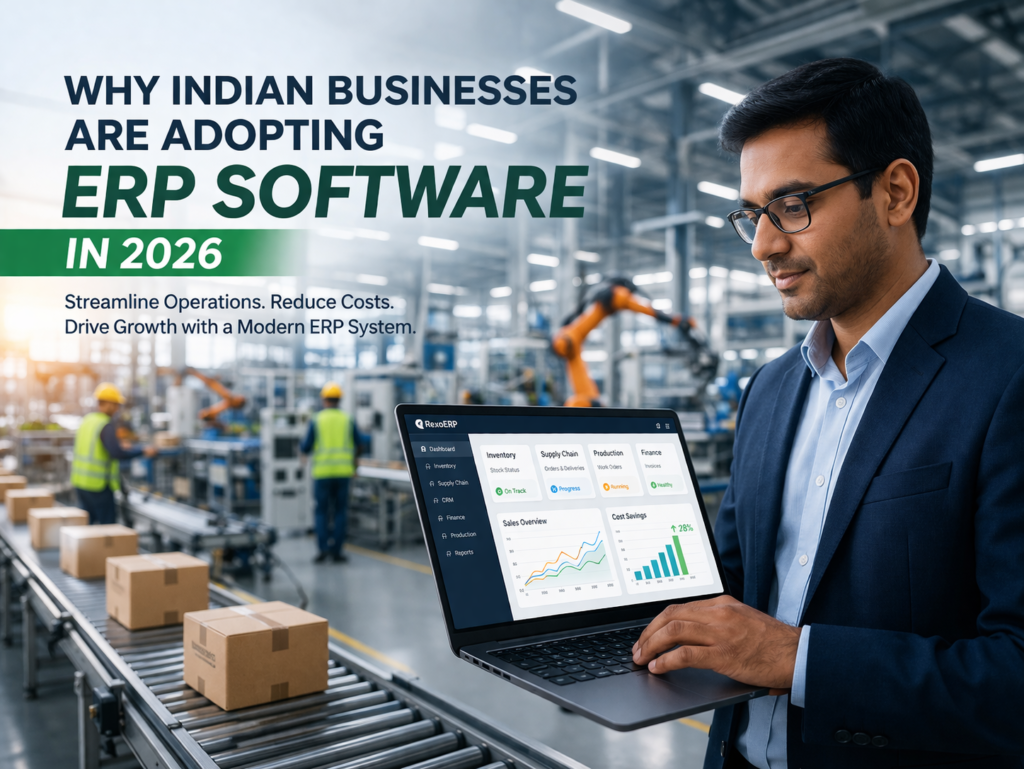

In today’s fast-moving business environment, Indian companies are under constant pressure to do more with less. Rising competition, complex supply chains, and increasing customer expectations are forcing businesses to rethink how they operate. Many organizations still rely on spreadsheets, disconnected tools, and manual processes—leading to inefficiencies, delays, and costly errors. This is where a modern ERP software solution helps businesses streamline operations, improve visibility, and stay competitive in a rapidly evolving market.
As markets become more dynamic and customer expectations continue to rise, businesses can no longer afford to operate in silos. Delayed decision-making, lack of real-time visibility, and poor coordination between departments often result in lost opportunities and reduced profitability. This is especially true for small and medium-sized enterprises (SMEs) that are trying to scale while managing limited resources.
This is where ERP (Enterprise Resource Planning) software is becoming a game-changer. In 2026, more Indian businesses than ever are adopting ERP solutions to streamline operations, improve efficiency, and gain a competitive edge. But what exactly is driving this rapid adoption?
Let’s dive deeper.
🚧 The Challenges of Running a Business Without ERP
Many businesses still operate using outdated systems that are not designed for modern demands. These challenges include:
Data Silos
Different departments use separate systems, making it difficult to access unified data.
Manual Errors
Human errors in data entry can lead to financial discrepancies and operational issues.
Lack of Real-Time Insights
Without real-time data, decision-making becomes slow and reactive.
Inefficient Processes
Repetitive tasks consume time and reduce productivity.
Poor Customer Experience
Delayed responses and order issues impact customer satisfaction.
For example, a manufacturing company relying on spreadsheets may struggle with inventory tracking, leading to stockouts or overstocking—both of which hurt profitability.
⚙️ How ERP Software Transforms Business Operations
ERP software integrates all core business functions into a single unified system. This eliminates data silos and ensures seamless communication across departments.
Key transformations include:
- Centralized Data Management
All business data is stored in one place, ensuring accuracy and consistency. - Automation of Routine Tasks
Reduces manual work and minimizes errors. - Real-Time Reporting
Enables faster and more informed decision-making. - Improved Collaboration
Teams can work together more efficiently with shared data. - Scalability
ERP systems grow with your business.
Instead of switching between multiple tools, businesses can manage everything from a single dashboard.
🔑 Key Features of Modern ERP Software
Modern ERP systems in 2026 are more advanced, flexible, and user-friendly than ever before.
📦 Inventory Management
Track stock levels, manage warehouses, and reduce wastage.
🔗 Supply Chain Management
Streamline procurement, logistics, and vendor management.
👥 CRM (Customer Relationship Management)
Manage leads, sales, and customer interactions efficiently.
💰 Financial Management
Handle accounting, billing, GST, and financial reporting.
🏭 Production Planning
Optimize manufacturing processes and resource allocation.
These features help businesses operate more efficiently and reduce operational complexity.
📈 Real Business Benefits of ERP
ERP adoption is not just about technology—it delivers real, measurable business outcomes.
🚀 Increased Efficiency
Automation reduces manual work and speeds up processes.
💸 Cost Reduction
Businesses can cut operational costs by up to 30%.
📊 Better Decision-Making
Real-time insights enable smarter business decisions.
📦 Improved Inventory Control
Avoid stockouts and overstocking.
😊 Enhanced Customer Satisfaction
Faster service leads to better customer experiences.
These benefits directly contribute to higher profitability and business growth.
🏭 Industry Use Cases: Manufacturing, Trading & SMEs
ERP software is widely used across different industries in India.
🏭 Manufacturing
- Production planning
- Raw material tracking
- Quality control
📦 Trading & Distribution
- Order management
- Warehouse tracking
- Logistics optimization
🏢 SMEs
- Business automation
- Financial control
- Scalable operations
ERP helps businesses in every sector streamline operations and scale efficiently.
🎯 Why Choosing the Right ERP Matters
Not all ERP systems deliver the same results. Choosing the wrong ERP can lead to:
- High implementation costs
- Low user adoption
- Limited functionality
- Scalability issues
A good ERP should be:
- Easy to use
- Customizable
- Scalable
- Industry-specific
Businesses should evaluate their needs carefully before selecting an ERP solution.
💡 The Shift Towards Cloud ERP in India
One of the biggest trends in 2026 is the rise of cloud-based ERP solutions.
Benefits of Cloud ERP:
- Lower upfront cost
- Easy implementation
- Remote accessibility
- Automatic updates
- High security
Cloud ERP is especially beneficial for SMEs looking for cost-effective solutions without heavy infrastructure investment.
🔄 Digital Transformation and ERP Adoption
ERP is at the core of digital transformation. Businesses are adopting ERP to:
- Replace manual processes
- Improve data accuracy
- Enable automation
- Gain competitive advantage
In a digital-first economy, ERP is no longer optional—it’s essential.
💼 Simplifying Business Operations with ERP
Modern ERP solutions simplify complex workflows and provide complete visibility into business operations.
For companies looking for a reliable ERP software solution, platforms like RexoERP offer an all-in-one system that integrates inventory, supply chain, CRM, finance, and production—helping businesses streamline operations and improve efficiency without complexity.
🚀 Final Thoughts
The adoption of ERP software among Indian businesses is growing rapidly—and for good reason. In a competitive market, efficiency, speed, and accuracy are critical for success.
Businesses that continue to rely on outdated systems risk falling behind, while those adopting ERP solutions are gaining a significant advantage.
If you’re planning to scale your business in 2026, investing in ERP software could be one of the smartest decisions you make. It not only improves efficiency but also lays the foundation for long-term growth and success.
This is where ERP (Enterprise Resource Planning) software is making a massive impact. Businesses across India are now adopting ERP solutions to streamline operations, improve decision-making, and stay competitive. But what exactly is driving this shift in 2026?
Let’s explore.
🚧 The Challenges of Running a Business Without ERP
Running a business without a centralized system creates multiple problems:
- Data scattered across different departments
- Inventory mismatches and stock issues
- Delayed order processing
- Lack of real-time insights
- Inefficient communication between teams
For example, a manufacturing company managing inventory manually may face stock shortages or overstocking—both of which directly impact profitability.
Without ERP, businesses often operate in silos, making it harder to scale efficiently.
⚙️ How ERP Software Transforms Business Operations
ERP software integrates all core business processes into a single platform. This means every department—inventory, sales, finance, HR, and production—works with the same real-time data.
Key transformations include:
- Automation of repetitive tasks
- Real-time reporting and analytics
- Improved collaboration across teams
- Better demand forecasting
- Faster decision-making
Instead of juggling multiple systems, businesses can manage everything from one dashboard.
🔑 Key Features of Modern ERP Software
A powerful ERP system in 2026 goes beyond basic functionality. It includes:
1. Inventory Management
Track stock levels, reduce wastage, and optimize inventory turnover.
2. Supply Chain Management
Manage procurement, logistics, and vendor relationships efficiently.
3. CRM (Customer Relationship Management)
Improve customer interactions and sales tracking.
4. Financial Management
Handle accounting, billing, and financial reporting seamlessly.
5. Production Planning
Plan and monitor manufacturing processes with precision.
📈 Real Business Benefits of ERP
Companies adopting ERP systems are seeing measurable improvements:
- Up to 30% reduction in operational costs
- Faster order processing and delivery
- Improved inventory accuracy
- Better resource utilization
- Increased overall productivity
ERP not only reduces costs but also boosts business growth by enabling smarter decisions.
🏭 Industry Use Cases: Manufacturing, Trading & More
ERP software is not limited to one industry—it’s transforming multiple sectors:
Manufacturing
- Production planning
- Raw material tracking
- Quality control
Trading & Distribution
- Order management
- Warehouse tracking
- Logistics optimization
SMEs
- Business automation
- Cost control
- Scalable growth
No matter the industry, ERP helps businesses operate more efficiently and scale faster.
🎯 Why Choosing the Right ERP Matters
Not all ERP systems are the same. Choosing the wrong one can lead to:
- High implementation costs
- Poor user adoption
- Limited scalability
The right ERP should be:
- Easy to use
- Customizable
- Scalable
- Industry-specific
This is why businesses must carefully evaluate their options before making a decision.
💡 Simplifying Business Operations with ERP
Modern ERP solutions are designed to simplify complex business processes. Instead of managing multiple tools, businesses can unify their operations under one system.
For companies looking for a reliable ERP software solution, platforms like RexoERP provide an all-in-one system that integrates inventory, supply chain, CRM, finance, and more—helping businesses streamline operations and improve efficiency.
🚀 Final Thoughts
The shift towards ERP software in India is no longer optional—it’s essential. Businesses that continue to rely on outdated systems risk falling behind in an increasingly competitive market.
By adopting the right ERP solution, companies can reduce costs, improve productivity, and unlock new growth opportunities.
If you’re planning to scale your business in 2026, investing in ERP software might be the smartest decision you make.
