
Introduction
The Dubai business environment keeps transforming quickly, with the companies in the area seeking agility, sustainability, and technological overview. The emirate office fit-out companies are providing innovative responses to address the emerging needs of employers, tenants, and occupiers. This paper discusses the key trends of the future that are influencing the sector and the driving forces and their implications for the stakeholders of industries.
The Emergence of Flexible and Hybrid Workplaces
The popularization of hybrid working models is one of the most crucial changes promoting the design of offices in the world. Dubai is not an exception, as organizations are refocusing their physical space to accommodate a mix of remote working and in-office work.
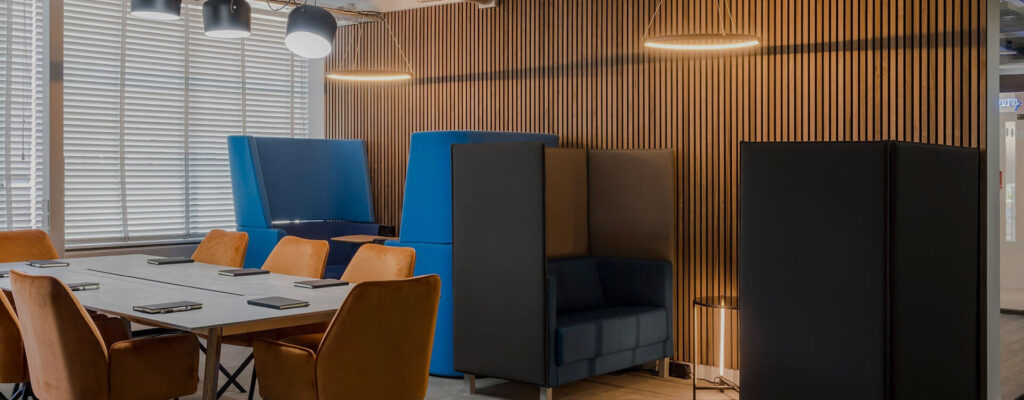
Conventionally, offices were made so that they were fully occupied with desks being allocated and the layouts fixed. The future, however, is from the perspective of dynamic spatial configurations that are easily reconfigured. Fit-out firms are working more on modular workstations, multi-purpose collaborative areas, and hot-desking areas to allow the utilization of specific space and functionality at its best.
The reason behind this is the necessity to promote autonomy and employee choice. Research findings have shown that the workers appreciate flexibility and having the choice to work where they are most productive. To reinforce this, fit-out providers are incorporating focused work, team, and social interaction spaces within the same footprint. The need to have flexible interiors will also increase as organizations make their hybrid policies perfect.
Wellness-Based and Sustainable Design
Environmental sustainability has shifted from being a corporate ambition to a regulatory and market requirement. The desire to achieve sustainable development that has been manifested in Dubai through the Dubai Clean Energy Strategy and Green Building Regulations is putting the office fit-out companies under pressure to provide solutions that are more environmentally friendly.
In the future, the office fit out company in Dubai will focus more on low-impact materials, energy-efficient systems, and building designs that will help create healthier interiors. These are the choice of recycled or locally obtained materials, high-performance glazing to minimize thermal gain, and furniture produced in a sustainable way.
Design thinking also focuses on wellness. Employers are becoming aware that a healthy built environment can increase productivity, minimize absenteeism, and increase employee satisfaction. Fit-out specialists are also integrating aspects of biophilic design that include natural lighting, plants, and air conditioning systems that provide the best air quality. The physical activity and relaxation areas are becoming more visible, which can be explained by the comprehensive vision of workplace wellness.
Smart Building Technologies Incorporated
Combining Internet of Things (IoT), automation, and digital monitoring technologies is turning the office fit-out into a smart space. Smart offices use sensors, cloud, and real-time analytics to enhance operational efficiency and occupant experience.
The trend towards smart city projects in Dubai is congruent with innovation in the workplace. Fit-out companies are taking technologies that check space use and environmental conditions. Indicatively, the presence of occupancy sensors can be used to manipulate the HVAC systems to act in accordance with the actual usage trends, and to save on energy without compromising comfort.
Intelligent conference rooms that have automated climate systems, light control systems, and electronic collaboration systems are the norm. The digital ecosystem also includes mobile apps enabling workers to reserve desks or conference rooms, find their coworkers, and get individually tailored building services. Due to the maturity and affordability of these technologies, their use in office fit-outs will increase faster.
Individualization With Data-Driven Design
Data analytics are transforming the design planning by the fit-out companies. In the past, space planning was highly dependent on demographic trends and qualitative insights. Now, companies are utilizing data on workplace analytics tools to get actionable information concerning the utilization of the space.
As an example, the occupancy data provided as heat maps may be used to identify areas that are not utilized to capacity and bottlenecks, which can be used to decide how to enlarge collaborative areas or create quiet spaces. Follow-up feedback within the digital environment, which is gathered after the occupation, allows for continuous improvement and a more responsive design.
Application of data does not just end with utilization measures. The demographic data relating to workforce preferences, performance analytics, and behavior patterns are used to develop customized surroundings that facilitate the organizational culture and productivity objectives. The office fit-out providers that are able to utilize such data and extract meaning will provide more personalized and relevant solutions.
Focus On the Expression of Culture and Brand
Corporate identity and culture are now being seen as tangible entities expressed in offices. The fit-out companies are not only being commissioned to maximize functionality but also to design spaces that are reminiscent of a brand, its heritage, and its goals and dreams.
In the multicultural business world of Dubai, with international businesses and local stakeholders in equal measures, office design becomes a competitive advantage. Others like branded interior, therefore, themed collaboration areas and custom-made art installations are used to support organizational stories.
This is the same trend towards the design language, which appeals both to employees and to consumers. Organizations are pursuing a setting that narrates a tale of creativity, diversity, and more. To fit-out experts, this requires embedding storytelling in design briefs in which brand and HR teams liaise to create spaces that support brand positioning and employee engagement strategies.
Lifecycle Costing and Circular Economy
This trend is taking shape in the shape of the circular economy, in which resources are reused, refurbished, or repurposed instead of discarded. The sustainability agenda of Dubai supports businesses to become less wasteful and shift to closed-loop systems.
Fit-outs are becoming circular by providing refurbishment and reconfiguration services to the existing assets to extend their lives. In place of full upgrades, clients have been choosing to upgrade the existing furniture, fixtures, and equipment (FF&E) in partial formats. Such a strategy lowers the expenses of projects, helps to lower material waste, and follows the corporate sustainability objectives.
The concept of lifecycle costing, where the total cost of ownership is taken into account throughout the lifespan of an asset, is also of importance to clients. This is necessitating the fit-out companies to come up with a cost-benefit analysis, taking into consideration maintenance, energy usage, and end-of-life value. Companies able to prove the cost-efficiency of circular strategies in the long run will be in the market in the coming years.
Partnership With Real Estate and Property Technology
The office fit-out industry is becoming more and more overlapping with real estate services and property technology (PropTech). Fit-out firms are collaborating with real estate brokers, landlords, and technology suppliers to provide turnkey services as occupiers require them.
These partnerships provide integrated experiences to customers in the pre-lease planning and space optimization to post-occupancy management. PropTech tools that handle leasing, facilities, and space usage information are being incorporated into the workflow of fit-out to offer full solutions to the workplace.
Such a collaborative ecosystem increases the openness, shortens lead time, and improves decision-making. It also allows the fit-out firms to be able to provide value-added advisory services, which places the firms as partner firms and not transactional ones.
Conclusion
The future of the office fit-out companies in Dubai is conditioned by strong trends that are reflections of the global tendencies in the work culture, sustainability requirements, and technological advancement. Competitive advantage in the sector will be characterised by flexibility, wellness, smart technologies, data-based design, brand expression, circular practices, and integrated service delivery.