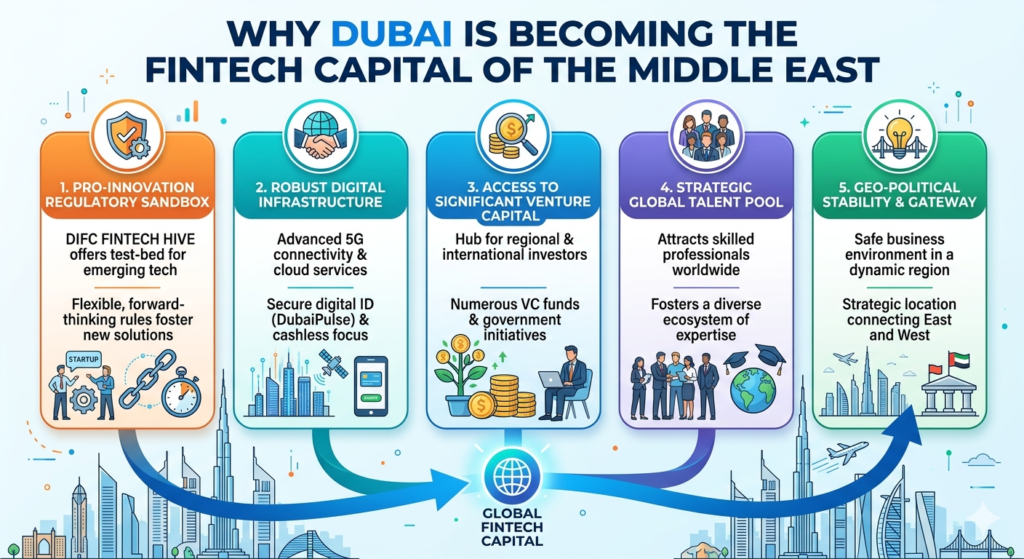

Not long ago, the financial landscape of the Middle East was dominated by traditional banking — conservative, slow-moving, and largely resistant to disruption. Today, that picture has changed dramatically. Dubai has emerged as the region’s undisputed FinTech powerhouse, attracting startups, global investors, and tech talent from every corner of the world. But what exactly is driving this transformation? And why Dubai, specifically?
The answer lies in a combination of visionary policy, strategic geography, world-class infrastructure, and a government that has made digital finance a national priority.
A Government That Moves at Startup Speed
One of the biggest obstacles FinTech companies face globally is regulation — or more precisely, the lack of regulatory clarity. Dubai has tackled this head-on. The Dubai Financial Services Authority (DFSA), operating within the Dubai International Financial Centre (DIFC), has built one of the most progressive FinTech regulatory frameworks in the world.
The DIFC FinTech Hive, launched in 2017, was the first financial technology accelerator in the Middle East, Africa, and South Asia (MEASA) region. It has since supported hundreds of startups through mentorship, regulatory guidance, investor access, and co-working facilities. Unlike many government initiatives that move slowly, DIFC’s programs operate at the pace the startup ecosystem demands — fast, iterative, and founder-friendly.
In 2020, the UAE Central Bank launched its FinTech Office, creating a dedicated channel for FinTech companies to engage with regulators. Shortly after, it introduced a regulatory sandbox — a safe environment for companies to test innovative financial products without facing full compliance requirements from day one. This sandbox approach has been a game-changer, allowing startups to experiment, fail fast, and scale smart.
The Numbers Tell the Story
Dubai’s FinTech ambitions are not just rhetoric — the data backs them up. According to industry reports, the UAE FinTech market is projected to surpass $4.5 billion by 2026. The country already hosts over 600 active FinTech companies, and that number is growing rapidly every quarter.
Investment is flowing in at record levels. Dubai FinTech startups have attracted hundreds of millions in venture capital, with notable deals in payments, lending, blockchain, and insurtech. The city regularly ranks among the top 20 global FinTech hubs, consistently outperforming far larger economies in terms of regulatory openness and speed to market.
In 2022, Dubai hosted the Global FinTech Fest and various DIFC-affiliated summits that drew thousands of founders, investors, and regulators from across the globe — cementing its status as the region’s definitive meeting place for financial innovation.
Strategic Location: The Bridge Between East and West
Geography has always been one of Dubai’s greatest assets, and in the world of FinTech, location still matters enormously. Dubai sits at the crossroads of Europe, Asia, and Africa — a position that gives companies based here unparalleled access to emerging markets.
For a FinTech startup eyeing expansion into South Asia, East Africa, or the broader Arab world, Dubai offers the ideal launchpad. Its time zone overlaps with business hours across three continents. Its airports connect to over 240 destinations. And its workforce draws from 200 nationalities, creating a talent pool of diverse financial expertise.
The city is also the regional headquarters for most of the world’s major banks, consultancies, and technology giants — which means FinTech companies can find partners, pilots, and enterprise clients without ever leaving the emirate.
Crypto, Blockchain & the Future of Money
Dubai has not shied away from the more controversial corners of financial technology. In fact, the city has actively embraced them.
In 2022, Dubai established the Virtual Assets Regulatory Authority (VARA) — the world’s first standalone regulator for virtual assets. This bold move sent a clear signal to the global crypto industry: Dubai is open for business, and it has the legal infrastructure to support it responsibly. Since then, major exchanges and blockchain firms, including Binance, OKX, and Crypto.com, have established significant operations in the city.
The Dubai Blockchain Strategy, part of the broader Dubai 2030 agenda, aims to move 50% of government transactions onto the blockchain — a move that would make Dubai one of the most blockchain-integrated governments in history. For FinTech companies building in the Web3 space, this institutional commitment is not just encouraging; it is transformative.
Talent, Lifestyle & the Golden Visa Effect
Even the best regulatory framework means nothing without talented people to build on it. Dubai has addressed this through aggressive talent attraction policies. The UAE’s Golden Visa program now extends to entrepreneurs, investors, and highly skilled professionals — offering 10-year renewable residency with no need for a local sponsor.
For FinTech founders and engineers who previously hesitated to relocate due to visa uncertainty, this is a significant shift. Dubai now offers the kind of residency security that allows individuals to plant roots, build teams, and think long-term.
The lifestyle factor should not be underestimated either. Low taxes, world-class healthcare, international schools, safety, and a cosmopolitan social scene make Dubai an easy sell to global tech talent. In the fiercely competitive war for FinTech talent, this quality of life advantage gives Dubai companies a meaningful edge over competitors based in cities with higher costs of living and complex immigration hurdles.
What the Future Holds
Dubai is not resting on its laurels. The emirate’s leadership has embedded financial technology into its long-term economic vision. The Dubai Economic Agenda D33, unveiled in 2023, targets doubling the size of the city’s economy over the next decade — with FinTech serving as a core pillar of that growth.
As artificial intelligence reshapes every sector of finance — from credit scoring and fraud detection to robo-advisory and algorithmic trading — Dubai is positioning itself to be at the leading edge of that wave. Partnerships between the DIFC and global AI research institutions are already underway, and government-backed incubators are specifically targeting AI-powered financial solutions.
For entrepreneurs, investors, and technologists looking to build the future of finance, the question is no longer why Dubai — it’s why not Dubai?
The FinTech capital of the Middle East has arrived. And it’s only getting started.
Also Read : Checklist for Choosing the Law Firm for Modern Business
Want to explore business setup options in Dubai’s FinTech sector? Connect with DIFC FinTech Hive or visit the DAFZA free zone portal for licensing information.